Few cuisines do “cozy dinner” quite like German cooking. There’s something almost architectural about the way these dishes are built — layers of flavor that develop slowly, ingredients that feel honest and grounding, and a heartiness that leaves you genuinely satisfied rather than stuffed on emptiness. A proper German meal doesn’t try to dazzle with technique. It earns your trust with depth.
What most people don’t realize is that the backbone of German home cooking — sausages, braised cabbage, potato dumplings, pan-fried cutlets — comes together faster than its reputation suggests. These aren’t dishes that demand culinary school training or a pantry full of obscure ingredients. A bag of potatoes, a few cuts of pork, a jar of sauerkraut, and some pantry spices take you a long way. The magic is in understanding how these flavors work together: that push-pull of sweet and sour, the richness of rendered pork fat, the earthy warmth of caraway and paprika.
Whether you grew up eating this food or you’re coming to it fresh, the recipes below represent the kind of weeknight German cooking that actually happens in home kitchens — not just at Oktoberfest celebrations. Each one is straightforward enough to pull off on a Tuesday but satisfying enough to feel like an occasion. The balance of effort to reward here is, frankly, hard to beat.
Table of Contents
- 1. Bratwurst and Sauerkraut with Beer Glaze
- Building the Beer Glaze
- What to Serve Alongside
- 2. Pork Schnitzel with Lemon and Pan Sauce
- The Breading Station Setup
- Frying for the Perfect Crust
- 3. German Potato Soup (Kartoffelsuppe)
- Choosing Your Potatoes
- The Smoky Element
- 4. Spaetzle with Browned Butter and Fresh Herbs
- The Spaetzle Maker Technique
- Finishing in Browned Butter
- 5. Beef Rouladen — German Stuffed Beef Rolls
- Assembling and Searing the Rolls
- The Braising Liquid and Gravy
- 6. German Potato Pancakes (Kartoffelpuffer)
- Removing the Excess Moisture
- Mixing and Frying
- 7. Slow-Cooked Sauerbraten with Gingersnap Gravy
- Making the Marinade
- Braising and the Gingersnap Trick
- 8. Frikadellen — German Pan-Fried Meat Patties
- The Meat Mixture
- Shaping and Frying
- 9. Braised Red Cabbage (Rotkohl) as a Warming Side
- The Flavor-Building Process
- Low and Slow is Non-Negotiable
- 10. Flammkuchen — German Flatbread Pizza with Crème Fraîche and Bacon
- Preparing the Topping
- Baking at High Heat
- Pairing Your German Dinner: Drinks, Sides, and Finishing Touches
- Final Thoughts
1. Bratwurst and Sauerkraut with Beer Glaze

If there’s one dish that captures the entire spirit of German cooking in a single pan, it’s bratwurst paired with sauerkraut. The combination sounds almost too simple, but the interplay between the fatty, snappy sausage and the sharp, fermented cabbage creates a balance that’s been refined over centuries for good reason. Add a beer glaze and you’ve moved from a weeknight staple into something you’d pay good money for at a German beer garden.
The key to making this dish sing is getting a proper sear on the bratwurst before anything else touches the pan. You want the skin to blister and turn deep golden-brown — that caramelization is where the flavor lives. Don’t rush this step by crowding the pan or using too high a heat; medium to medium-high works best.
Building the Beer Glaze
Once your brats are seared, pour in about half a cup of a German lager or amber ale — nothing too dark, which can turn bitter when reduced. The liquid will bubble aggressively at first, loosening all those browned bits from the pan floor. Let it reduce by half before adding the sauerkraut, which you should drain but not rinse (that brine carries flavor). Scatter in a teaspoon of caraway seeds, a pinch of sugar, and a tablespoon of whole-grain mustard.
What to Serve Alongside
- Potato rolls or crusty rye bread for mopping up the pan juices
- Stone-ground German mustard on the side — always
- A cold lager beer or a dry Riesling if you’re feeling civilized
- Boiled or roasted potatoes seasoned with parsley and butter
The whole process takes about 25 minutes from start to finish. You can use bratwurst, knockwurst, or any fully-cooked German-style sausage. If you have leftovers, they reheat beautifully the next day and actually taste better after the flavors have had time to meld overnight.
Worth knowing: Sauerkraut from a glass jar (sold refrigerated) has a cleaner, more complex flavor than the canned variety. If you can find it, it’s worth the small extra cost.
2. Pork Schnitzel with Lemon and Pan Sauce
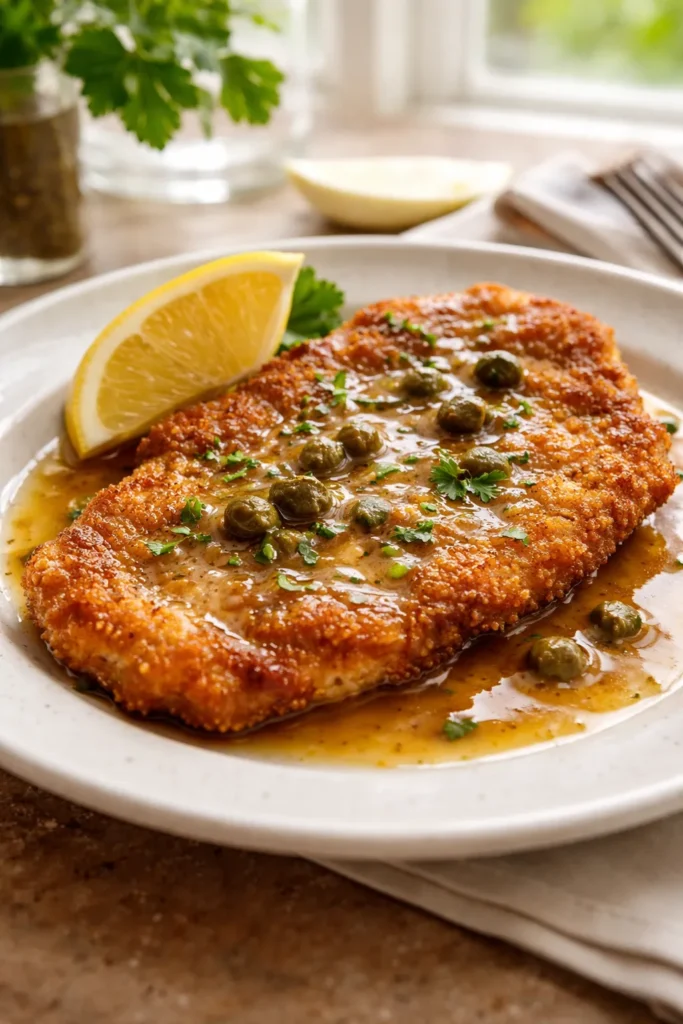
Schnitzel is the dish that introduced a lot of people to German (and Austrian) cooking, and it deserves every bit of that reputation. A properly made pork schnitzel — pounded thin, breaded in fine breadcrumbs, and fried in hot fat until the coating puffs and crisps — is one of the most satisfying things you can put on a weeknight plate. The lemon wedge isn’t just garnish; that squeeze of acid cuts through the richness in a way that makes the whole thing feel lighter than it is.
The single most important step is pounding the cutlet to an even thickness of about ¼ inch. Uneven thickness means parts overcook while others stay underdone. Place the pork between two sheets of plastic wrap and use a meat mallet or the bottom of a heavy pan. Work from the center outward.
The Breading Station Setup
Set up three shallow dishes in a row: seasoned flour first, then beaten egg with a splash of whole milk, then fine dried breadcrumbs (plain panko also works and gives a slightly more textured crust). Dredge each cutlet through flour, shake off the excess, dip in egg, then press firmly into the breadcrumbs on both sides. Let the breaded cutlets rest on a wire rack for 10 minutes before frying — this helps the coating adhere and stay crispy.
Frying for the Perfect Crust
Use a wide, heavy pan and enough neutral oil (or clarified butter) to come about ¼ inch up the sides. The fat needs to be genuinely hot — around 350°F — before the schnitzel goes in. Each side takes about 2 to 3 minutes. The coating should be a deep, even amber color, not pale gold.
- Avoid pressing down on the schnitzel while it fries — that’s what keeps the coating puffed and light
- Rest on a paper towel-lined rack, not a flat plate, to prevent steam from softening the crust
- Finish with a squeeze of fresh lemon and a sprinkle of flaky salt
- A quick pan sauce of chicken stock, cream, and capers (Jäger-style) turns this into a full restaurant-quality meal
Pro tip: Don’t overcrowd the pan. Fry one or two cutlets at a time, and let the oil come back up to temperature between batches.
3. German Potato Soup (Kartoffelsuppe)
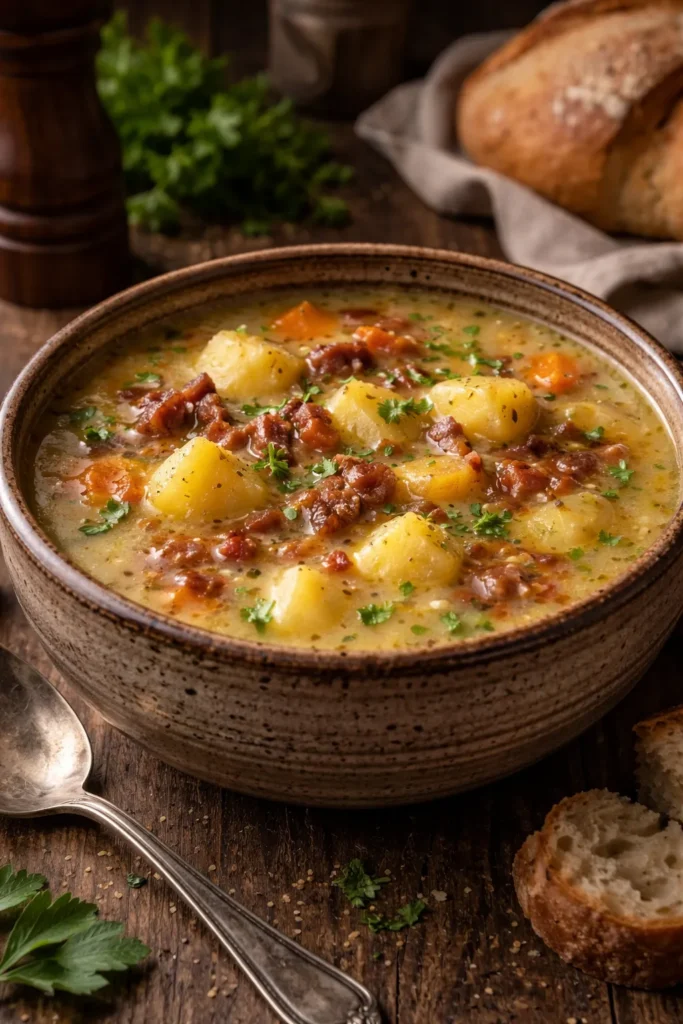
German potato soup is the kind of dish that makes you understand why potatoes became a cornerstone of this cuisine. It’s not a thin, watery broth with a few potato cubes floating around. Done properly, Kartoffelsuppe is thick, deeply savory, smoky from bacon or smoked sausage, and so filling it could pass as a complete meal with a slice of rye bread on the side.
The flavor foundation here is a proper sauté of diced onion, celery root, and carrot in butter — these aromatics need about 8 minutes over medium heat until they’re soft and beginning to turn translucent before the stock goes in. Rushing this step produces a flat-tasting soup.
Choosing Your Potatoes
Starchy potatoes like Russets or Yukon Golds break down beautifully and naturally thicken the soup as it simmers. Waxy varieties hold their shape but don’t lend that silky, cohesive body that makes Kartoffelsuppe so comforting. Cut the potatoes into roughly 1-inch cubes so they cook evenly and some pieces dissolve into the broth while others remain intact — that textural contrast is part of the appeal.
The Smoky Element
A handful of finely diced speck, smoked bacon, or sliced smoked sausage (kielbasa works well) adds the characteristic depth. Render this out in the pot first, remove it, and build the vegetable sauté in the same fat. Return the smoky meat at the end.
- Season with marjoram — a dried herb used constantly in German cooking that most American recipes skip
- A bay leaf and a few whole black peppercorns go in with the stock
- Finish with a swirl of sour cream or crème fraîche stirred in off the heat
- Serve garnished with fresh chives, a small pour of good oil, and crispy bacon bits
This soup keeps in the fridge for up to 4 days and thickens as it sits. Thin with a splash of stock when reheating.
4. Spaetzle with Browned Butter and Fresh Herbs
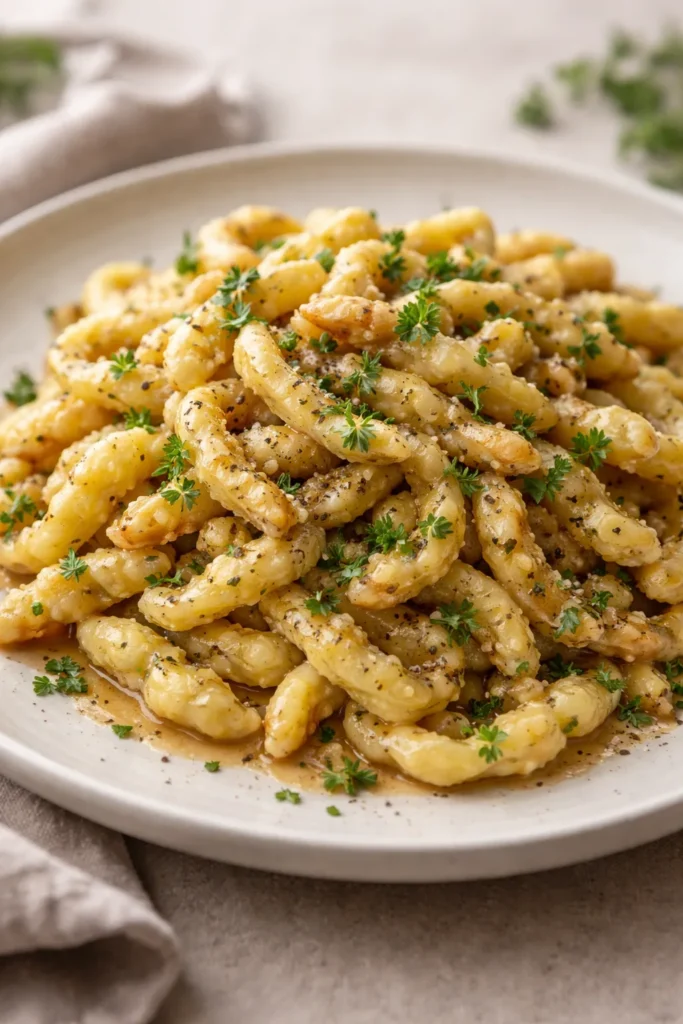
Spaetzle might be the most underrated German dish outside of Germany itself. Described as a cross between egg noodles and tiny dumplings, they have a texture that’s genuinely their own — slightly chewy, tender throughout, and with an egg-rich flavor that pairs beautifully with almost any German main course. They’re also much faster to make than their impressive name suggests.
The batter is simple: flour, eggs, whole milk, salt, and a pinch of nutmeg whisked together until smooth and thick enough to fall from a spoon in a slow ribbon. The specific ratio matters — roughly 2 cups flour to 3 eggs to ½ cup milk produces a batter that’s thick but still pourable.
The Spaetzle Maker Technique
You can push the batter through a dedicated spaetzle maker (a flat grater-like tool that sits over the pot), through a colander with large holes, or through a box grater held over boiling salted water. Each approach produces a slightly different shape, but the texture is largely the same. Work in batches — the spaetzle are done when they float to the surface, usually within 2 to 3 minutes. Transfer each batch with a slotted spoon directly to an ice bath, then drain.
Finishing in Browned Butter
This is where the dish goes from good to exceptional. Melt 3 tablespoons of unsalted butter in a wide skillet over medium heat and let it continue cooking, swirling occasionally, until it turns a deep amber color and smells nutty — about 4 to 5 minutes. Add the drained spaetzle to the pan and toss to coat, letting them toast slightly in the butter for another minute or two.
- Finish with a generous handful of fresh flat-leaf parsley or chives
- Käsespätzle — the German version of mac and cheese — is made by layering spaetzle with grated Emmental and caramelized onions and broiling until bubbly
- Spaetzle also works as the base for slow-braised meat dishes in place of egg noodles
- Leftovers can be pan-fried the next day in butter until crispy on the outside
5. Beef Rouladen — German Stuffed Beef Rolls
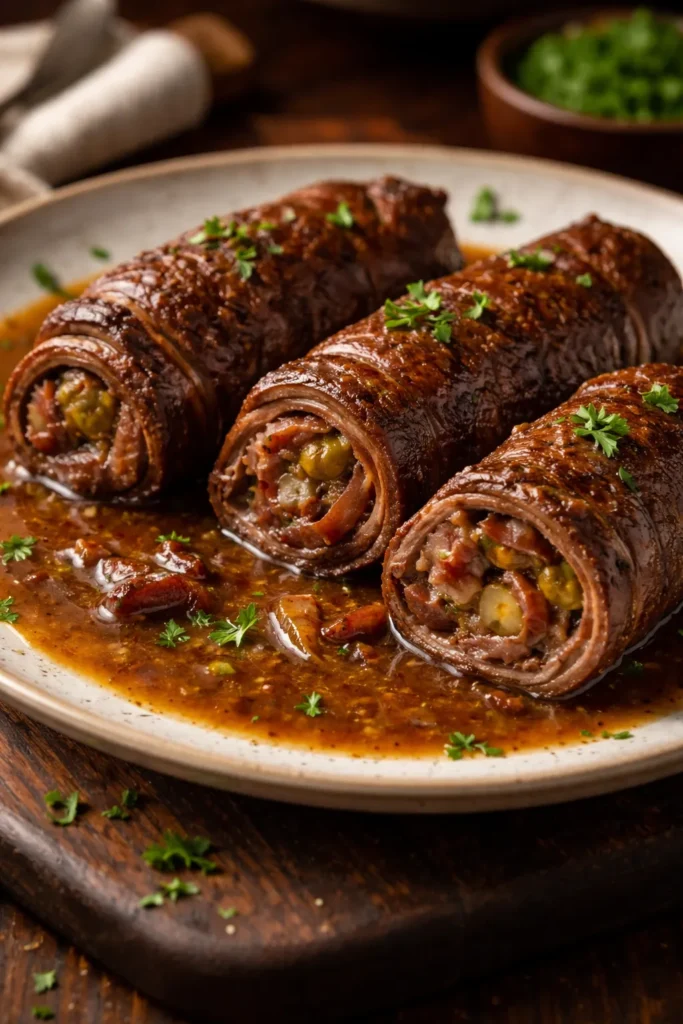
Beef rouladen is the Sunday dinner of German cooking — the dish that appears at family tables for celebrations, cold-weather gatherings, and holidays. Thin slices of beef are spread with mustard, layered with bacon, sliced onion, and a whole dill pickle, then rolled tightly and braised low and slow in beef stock until fork-tender. The braising liquid reduces into a gravy so good you’ll want to drink it.
The cut of beef matters. You want thinly sliced top round or flank steak, ideally cut by a butcher to about ¼-inch thickness. Each slice should be about 4 inches wide and 6 to 8 inches long — large enough to roll around the filling without bursting.
Assembling and Searing the Rolls
Lay each beef slice flat and spread a thin layer of spicy German mustard across the surface, leaving a half-inch border. Lay two strips of bacon across the width, then add a few rings of raw onion and one dill pickle spear. Roll the beef tightly around the filling from the short end, and secure with kitchen twine or a couple of toothpicks. The rolls need a serious, deep sear in hot oil in a Dutch oven or heavy braising pot — at least 3 to 4 minutes per side until genuinely browned, not just gray.
The Braising Liquid and Gravy
Remove the seared rolls and sauté diced onion, carrot, and celery root in the same pot until softened. Add a tablespoon of tomato paste, cook for 2 minutes, then pour in 1½ cups of beef stock and ½ cup of red wine. Nestle the rolls back in, cover, and braise at 325°F for 90 minutes.
- The braising liquid makes the gravy — strain it, reduce by one-third, then whisk in a butter-flour mixture to thicken
- Serve with potato dumplings (Kartoffelklöße) or spaetzle to absorb the gravy
- Rouladen can be made 2 days ahead and reheated gently — they actually improve as the flavors deepen
- Don’t skip the pickle — it sounds unusual but it’s the flavor anchor of the whole dish
6. German Potato Pancakes (Kartoffelpuffer)
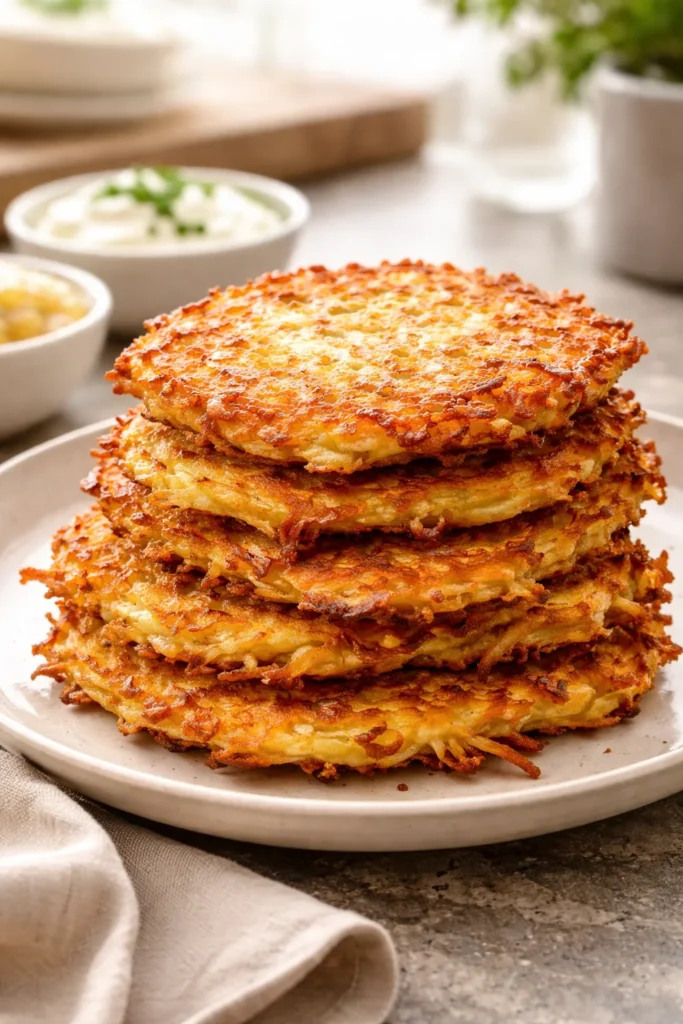
Potato pancakes — Kartoffelpuffer in German — occupy a special place in the cooking of both home kitchens and street food stalls across Germany. They’re crispy-edged, tender-centered, savory from onion and seasoning, and completely addictive. Served sweet with applesauce or savory alongside bratwurst and sour cream, they’re one of those dishes that works at any time of day.
The grating method makes a genuine difference. A box grater on the coarse side produces longer shreds that create a lacier, crispier pancake. A food processor with a grating disc is faster but creates shorter shreds that cook up denser. Both are acceptable — it comes down to your texture preference.
Removing the Excess Moisture
This step separates good Kartoffelpuffer from great ones. After grating the potatoes, transfer them to a clean kitchen towel and wring out as much liquid as possible — and mean it, really squeeze. Excess potato water prevents crisping and leads to soggy, pale pancakes. Let the wrung-out liquid sit in a bowl for a minute, then carefully pour off the liquid and add the potato starch sediment at the bottom back to the grated potatoes. That starch helps bind the pancakes without needing extra flour.
Mixing and Frying
Combine the drained potatoes with a finely grated onion, 1 beaten egg, salt, white pepper, and 2 tablespoons of all-purpose flour. Mix well. Heat a generous pour of neutral oil in a heavy skillet — enough to come about ¼ inch up the sides — until shimmering. Add heaping spoonfuls of the potato mixture and press flat with the back of the spoon. Fry undisturbed for 3 to 4 minutes per side.
- Never cover the pan while frying — steam destroys the crispy crust
- Keep finished pancakes warm on a wire rack in a 200°F oven while you fry subsequent batches
- The classic accompaniment is cold applesauce and sour cream served simultaneously
- For a heartier version, top with crème fraîche, smoked salmon, and a scatter of fresh dill
7. Slow-Cooked Sauerbraten with Gingersnap Gravy
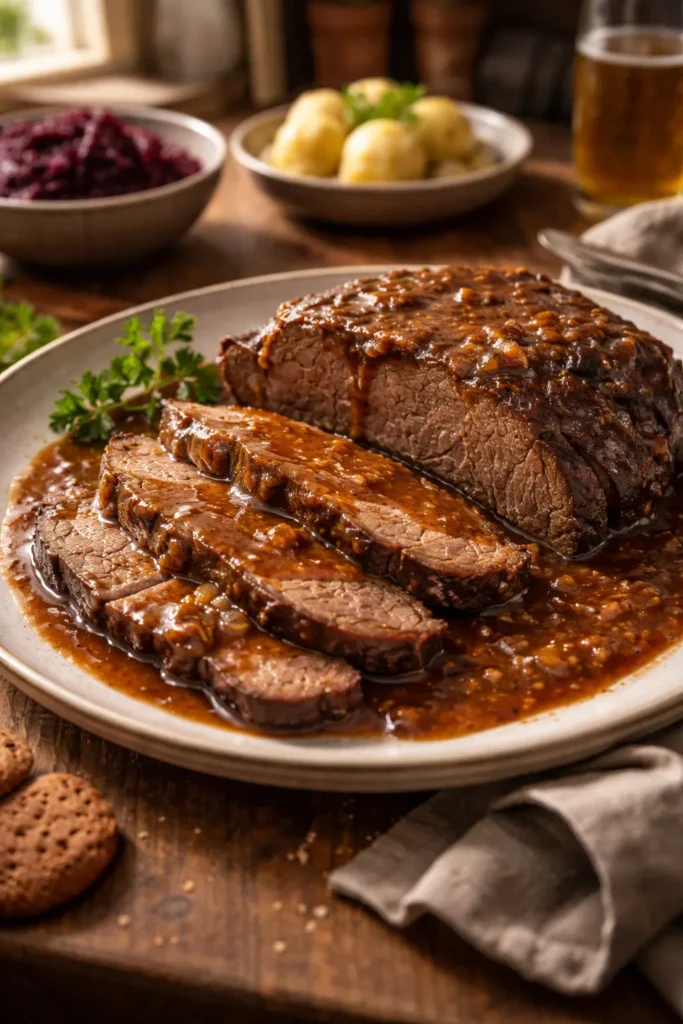
Sauerbraten is German pot roast elevated by one brilliant technique: marinating the beef in a sweet-sour bath of vinegar, wine, spices, and aromatics for anywhere from 24 hours to 3 days before cooking. That marinade does two things simultaneously — it tenderizes even tough cuts of beef and imprints those complex sweet-sour flavors deep into the meat. The gravy, made from the reduced marinade and thickened with crushed gingersnap cookies, is unlike any pan sauce in any other cuisine.
Use a chuck roast or bottom round — about 3 to 4 pounds. Nothing leaner, because this dish needs fat marbling to stay moist through the long braise.
Making the Marinade
Combine equal parts red wine vinegar and red wine (about 1 cup each) with 1 cup of water, 1 sliced onion, 2 bay leaves, 8 black peppercorns, 4 whole cloves, 1 tablespoon brown sugar, and a pinch of dried thyme. Bring this to a simmer, then cool completely before submerging the beef. Keep it refrigerated in a zip-lock bag or covered bowl, turning the meat once a day.
Braising and the Gingersnap Trick
Remove the beef from the marinade (save every drop of it), pat dry, and sear aggressively in a Dutch oven. Strain the marinade and pour it over the seared roast along with enough beef stock to come halfway up the sides. Braise at 325°F for 2.5 to 3 hours until the meat pulls apart with gentle pressure.
- The gingersnap gravy: Strain the braising liquid, reduce by one-third, then whisk in 6 to 8 crushed gingersnap cookies — they melt in and thicken the sauce while adding a subtle spice and sweetness
- Add a tablespoon of raisins and a splash of red wine vinegar to balance the sweetness
- Serve sliced over egg noodles, spaetzle, or potato dumplings
- Sauerbraten made in a slow cooker on low for 8 hours produces equally tender results
8. Frikadellen — German Pan-Fried Meat Patties
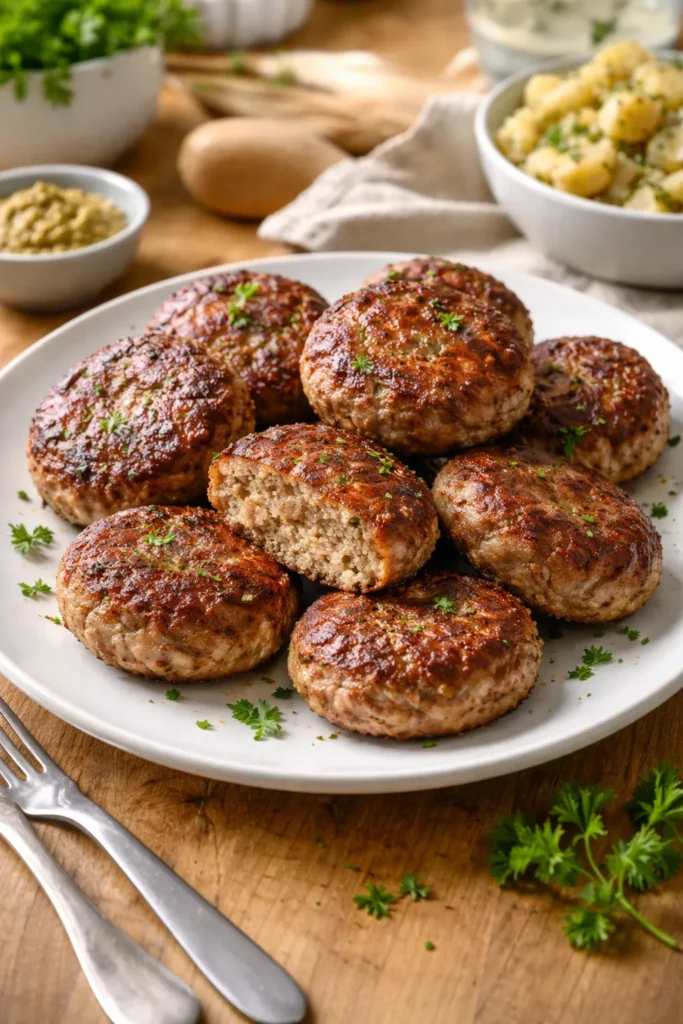
Frikadellen are, technically speaking, the ancestors of the American hamburger — and they’re better in almost every way. These are pan-fried meat patties made from a mixture of ground pork and beef, seasoned with onion, mustard, marjoram, and a soaked bread roll that keeps them incredibly moist. They’re coarser and more flavorful than a typical burger patty, and they’re eaten in Germany the same way Americans eat meatloaf — hot with gravy and sides, or cold the next day in a sandwich.
The bread roll soaked in milk is the secret weapon. Tear a day-old white roll into chunks, soak in whole milk for 5 minutes, then squeeze out most of the liquid and mix the softened bread directly into the meat mixture. It creates a texture that’s tender and loose rather than dense and rubbery.
The Meat Mixture
Combine ½ pound ground pork and ½ pound ground beef in a large bowl. Add the squeezed bread, 1 finely minced onion that’s been softened in butter and cooled, 1 egg, 1 teaspoon each of German mustard and sweet paprika, 1 teaspoon dried marjoram, salt, and plenty of black pepper. Mix with your hands until just combined — don’t overwork the mixture, which toughens the patties.
Shaping and Frying
Form the mixture into oval patties about ¾ inch thick. The oval shape is traditional and not just aesthetic — it provides a larger surface area for browning, which means more crust and more flavor. Fry in a mixture of butter and oil over medium-high heat for about 4 minutes per side until deeply browned and cooked through to 160°F internal temperature.
- Serve with German potato salad or braised red cabbage for a complete traditional meal
- Cold Frikadellen are a staple in German households — slice and eat on bread with mustard the next day
- A small amount of finely grated raw onion mixed into the raw meat adds brightness
- These freeze well individually wrapped and reheat beautifully in a 350°F oven for 15 minutes
9. Braised Red Cabbage (Rotkohl) as a Warming Side
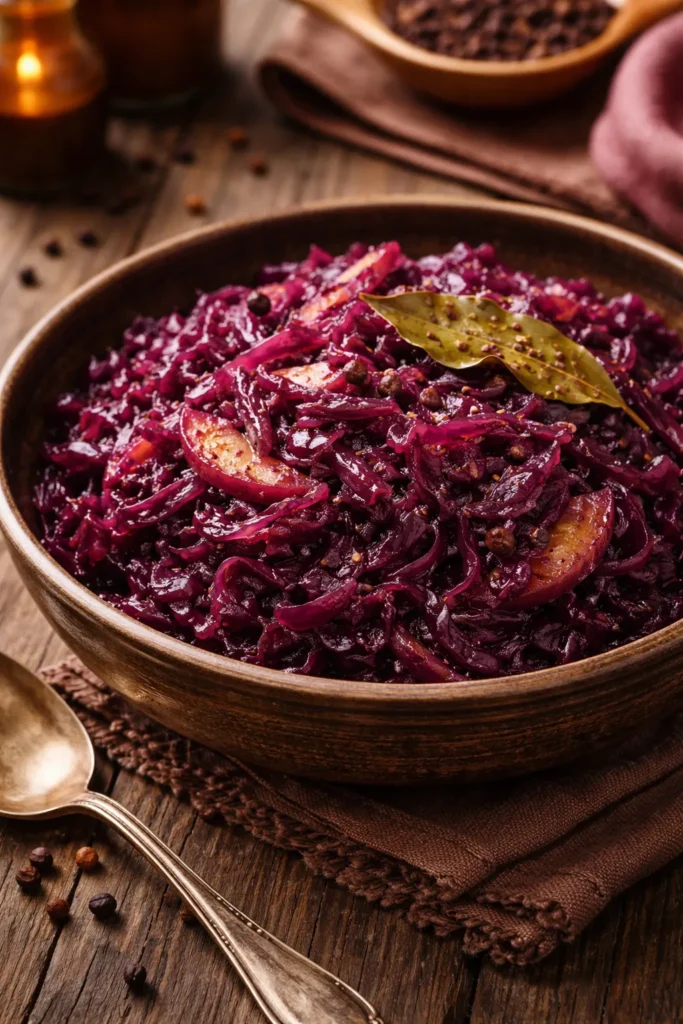
Red cabbage braised with apple, vinegar, and spices is one of the most versatile and deeply satisfying side dishes in German cooking. It appears on virtually every traditional dinner table — alongside sauerbraten, with pork roast, next to duck or goose at holiday meals. The color alone is remarkable: what begins as vibrant purple cabbage cooks down into something jewel-red and glossy, tender but still with a slight bite.
What’s less obvious until you make it yourself is how much the sweet-sour balance defines this dish. The vinegar provides acidity; the apple (and often a small amount of sugar or red currant jelly) rounds it out. Get that balance right and you have something that genuinely completes any hearty German plate.
The Flavor-Building Process
Start by rendering 2 strips of diced bacon in a large pot until crispy. Remove the bacon and soften 1 finely sliced red onion in the fat. Add 1 small head of red cabbage, cored and very thinly sliced — around 6 cups — along with 1 peeled and diced tart apple (Granny Smith works well), 3 tablespoons of apple cider vinegar, 1 tablespoon of brown sugar, ½ teaspoon each of ground cloves and caraway seeds, and a bay leaf. Pour in ½ cup of red wine or apple juice.
Low and Slow is Non-Negotiable
Cover and braise over low heat for at least 45 minutes, stirring occasionally, until the cabbage is completely tender and the liquid has reduced to a glossy coating. Taste and adjust — if it’s too sharp, add a little more sugar or a spoonful of red currant jelly. If it’s flat, a splash more vinegar brings it back.
- Rotkohl improves enormously overnight — make it a day ahead and reheat for the best flavor
- It freezes well in airtight containers for up to 3 months
- Omit the bacon for a fully vegetarian version using butter instead
- A pinch of ground allspice alongside the cloves adds a warmly spiced depth that’s distinctly Bavarian
10. Flammkuchen — German Flatbread Pizza with Crème Fraîche and Bacon
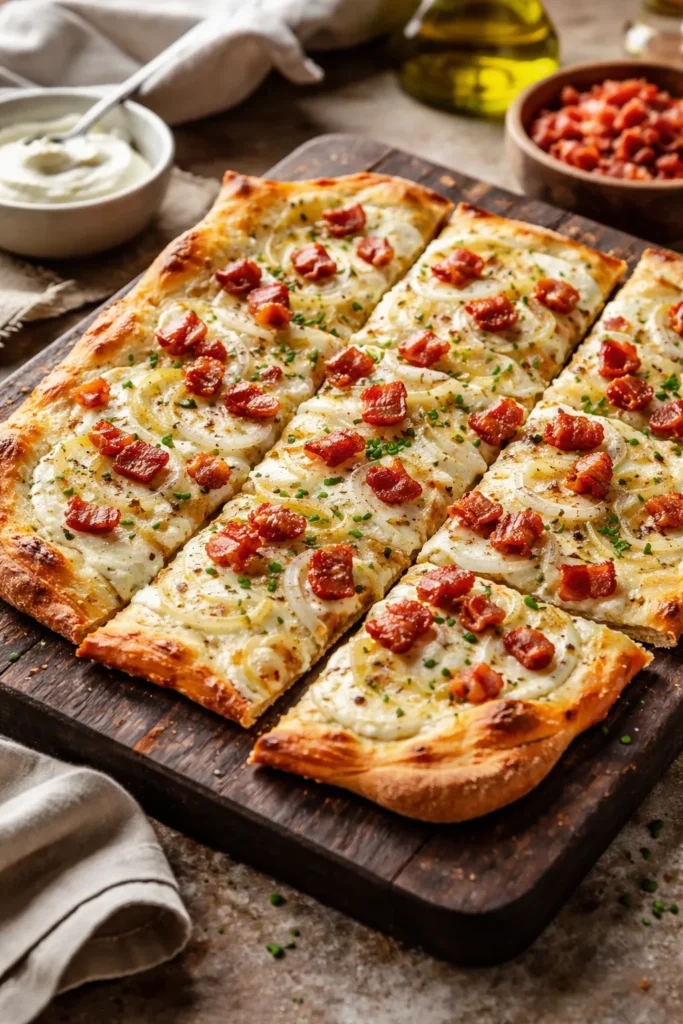
Flammkuchen — literally “flame cake” — comes from the Alsace region on the French-German border, and it’s one of those dishes that feels festive and easy at the same time. Think of it as a very thin-crust flatbread covered with crème fraîche instead of tomato sauce, then topped with thinly sliced onions and smoky bacon lardons. It bakes at high heat in 10 to 12 minutes, arrives at the table crackling and fragrant, and disappears almost immediately.
The dough is lean — just flour, water, oil, and salt, with no yeast — which means it comes together in minutes and needs only a brief rest, not a rise. Roll it as thin as you can manage, ideally to about ⅛ inch, on a floured surface.
Preparing the Topping
The crème fraîche base should be seasoned with salt, white pepper, and a small pinch of nutmeg before spreading. Use it generously across the dough, leaving a ½-inch border. Scatter over very thinly sliced white onion (not caramelized — they’ll cook in the oven), and distribute thin lardons of smoked bacon or pancetta across the surface.
Baking at High Heat
The oven needs to be as hot as it will go — 500°F to 550°F if your oven allows. Slide the Flammkuchen onto a preheated baking stone or a hot sheet pan and bake for 10 to 12 minutes until the edges are charred in spots, the bacon is crispy, and the onions are softened and beginning to caramelize.
- Cut with a pizza wheel and eat immediately — Flammkuchen does not improve with time
- Classic additions include fresh thyme, grated Gruyère, or a scatter of fresh arugula added after baking
- For a sweet version, spread with crème fraîche, thin apple slices, and a drizzle of honey with a pinch of cinnamon
- Serve as a starter before a main of schnitzel or braised meat, or as a light dinner on its own with a green salad
Pro tip: If you have a cast iron pan, heat it in the oven while preheating, then slide the Flammkuchen directly onto it for a bottom crust that rivals a wood-fired oven.
Pairing Your German Dinner: Drinks, Sides, and Finishing Touches
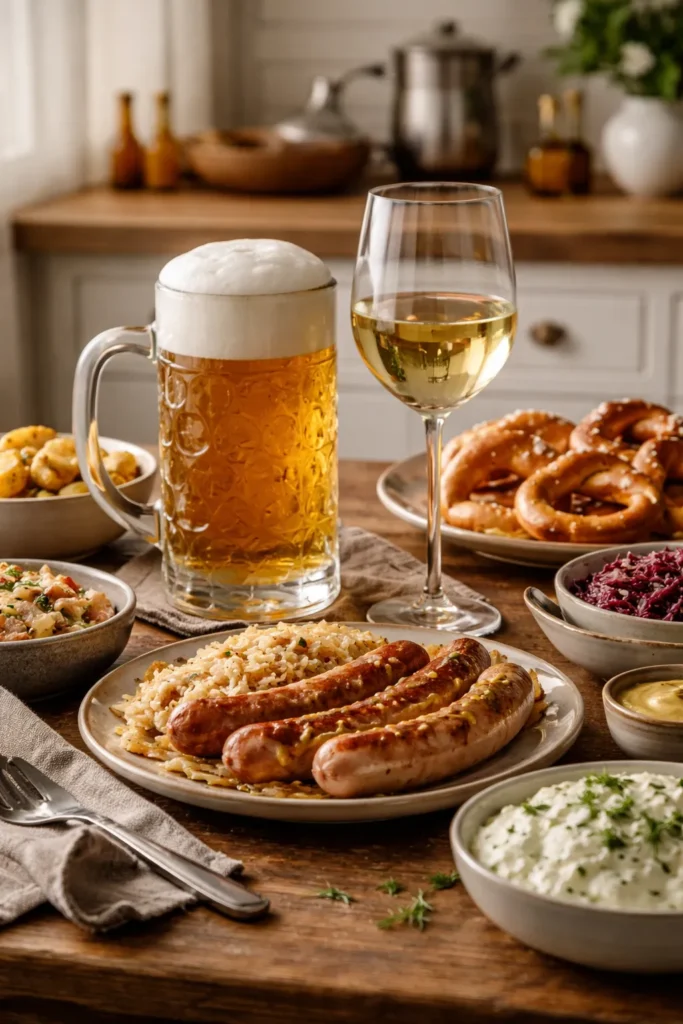
German cooking is built around complementary flavors, and the right drink or side dish can pull a meal together in a way that feels genuinely complete rather than just assembled.
For beer pairings, a Märzen or amber lager pairs naturally with almost every dish on this list — its malt sweetness holds up against the vinegar notes in sauerbraten and rouladen, and its light carbonation cuts through the richness of schnitzel or Frikadellen. A wheat beer (Hefeweizen) works beautifully with lighter dishes like Flammkuchen or potato pancakes.
Wine-wise, a German Riesling — specifically a Spätlese with a touch of residual sweetness — is the most food-friendly wine produced anywhere in Europe. Its acid structure and fruit notes cut through fatty pork dishes and complement the sweet-sour elements in braised cabbage and sauerbraten. For the beef-forward dishes like rouladen, a Spätburgunder (German Pinot Noir) is the traditional pairing and a genuinely elegant one.
For side dishes, think in terms of balance:
- Rich, fatty mains (schnitzel, Frikadellen, rouladen) pair best with acidic sides like German potato salad dressed with vinegar and mustard, or braised red cabbage
- Lighter mains (Flammkuchen, potato pancakes) welcome creamy, cool accompaniments like sour cream, crème fraîche, or a simple cucumber salad dressed with dill and vinegar
- Braised and slow-cooked dishes (sauerbraten, sausage and sauerkraut) need starch to absorb the sauce — spaetzle, potato dumplings, or buttered egg noodles all work
One thing you’ll notice making these recipes: German cooking uses a relatively short list of pantry staples repeatedly, which means once you’ve stocked up, you can make any of these dishes without a special shopping trip. Caraway seeds, marjoram, sweet paprika, whole-grain German mustard, apple cider vinegar, and smoked bacon appear again and again. Build that pantry once and the cooking becomes genuinely effortless.
Final Thoughts
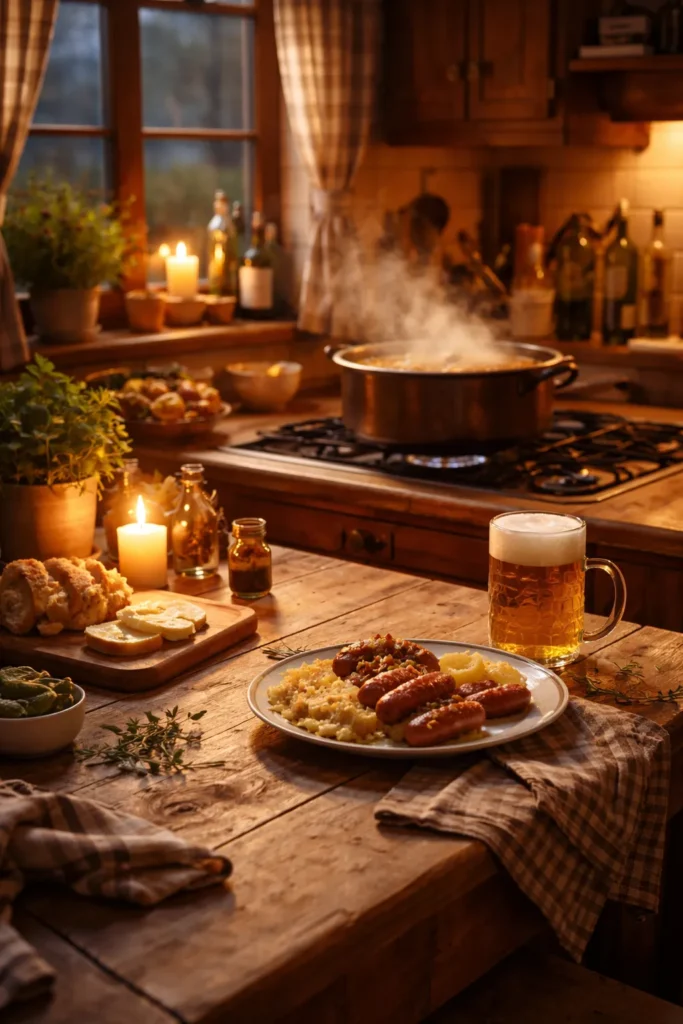
What makes German home cooking so durable is its honesty. There’s no pretension in a pan of bratwurst glazed with beer and served over sauerkraut. No artifice in a bowl of potato soup or a plate of crisped Kartoffelpuffer. These are dishes built to nourish people through cold evenings and long weeks, and they do exactly that — every single time.
The sweet-sour thread that runs through so much German cooking (vinegar against sugar, fatty pork against tart cabbage, pickles inside buttery beef rolls) is one of the most satisfying flavor principles in any culinary tradition. Once you understand it, you start seeing it everywhere in these recipes, and you start reaching for it instinctively in your own cooking.
Start with whichever dish appeals most — maybe the quick weeknight schnitzel, or the Flammkuchen for a low-effort dinner party moment. Then work your way through. You might find, as many home cooks do, that German food becomes one of your most-reached-for culinary repertoires. Simple ingredients, big payoff, and a warmth in every bowl that’s hard to replicate anywhere else.