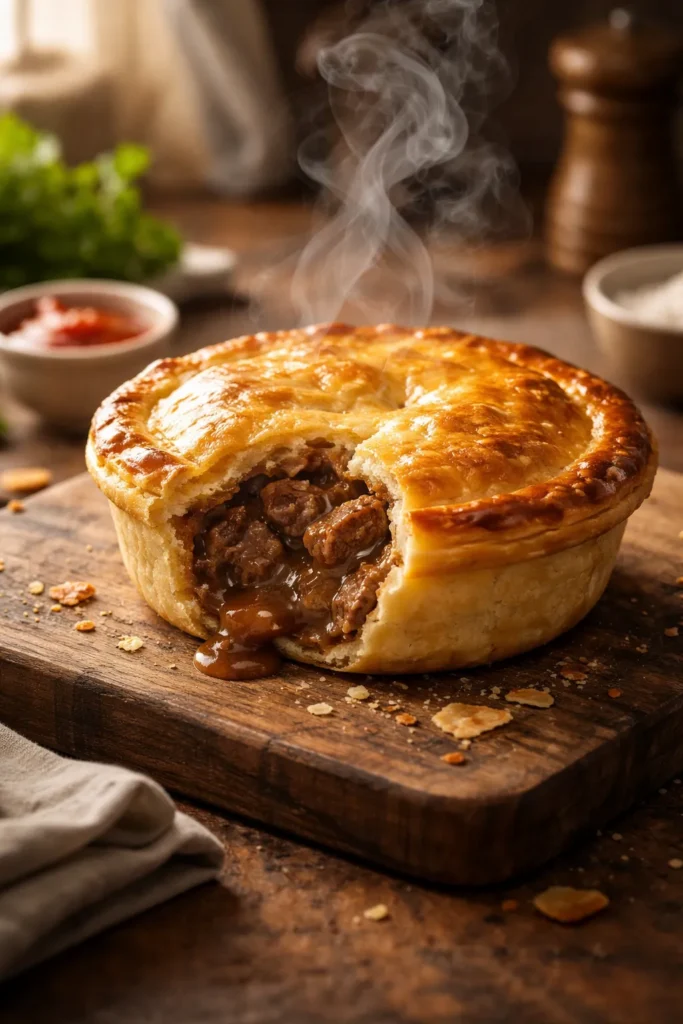
There’s a moment every Australian knows by heart — you bite through the golden, shattering puff pastry lid, the gravy oozes out onto your fingers, and you burn the roof of your mouth because you absolutely could not wait. You knew it was too hot. You did it anyway. Zero regrets.
The humble meat pie holds a place in Australian culture that’s hard to overstate. It’s the thing you grab at the footy, the road trip snack you detour off the highway for, the midnight post-pub necessity, and the lunch that Australians living overseas dream about constantly. Ask any expat what they miss most about home, and meat pies are almost always in the top three — right up there with the beach and Vegemite on toast.
What separates a genuinely great meat pie from a forgettable one comes down to three things: the quality of the filling, the richness of the gravy, and the texture of the pastry. The magic combination of a buttery shortcrust base (sturdy enough to hold in your hands without collapsing) and a golden, flaky puff pastry lid is what defines the authentic Aussie pie experience. Nail those elements and you’ve got something that rivals — honestly, often beats — anything from a bakery.
The eight recipes below cover the full spectrum of Australian meat pie tradition, from the beloved old-school mince version you’d find in a suburban bakery to the slow-braised chunky beef version that takes all day and rewards you like nothing else. Whether you’re an Aussie expat hunting for a taste of home or someone making these for the first time, every one of these recipes is built to deliver that oozy, flaky, deeply satisfying result.
Table of Contents
- Why Australian Meat Pies Are Worth Making From Scratch
- The Time Investment Is Real — But So Is the Payoff
- The Pastry Combination That Makes Every Aussie Pie Great
- Shortcut vs. Scratch: What to Use
- 1. Classic Chunky Chuck Beef Pie
- What You Need
- Why This Version Stands Above the Rest
- 2. Old-School Beef Mince Pie
- What You Need
- The Dark Soy Sauce Secret
- 3. Beef and Guinness Pie
- What You Need
- Building the Stout Gravy
- 4. Bacon and Beef Mince Pie
- What You Need
- The Curry Powder Question
- 5. Vegetable-Loaded Mince Pie
- What You Need
- Keeping the Vegetables Distinct
- 6. Family-Size Sharing Pie
- Adapting Individual Pie Recipes to Family Size
- Why the Shortcrust Base Still Matters in a Large Pie
- 7. Curry-Spiced Beef Mince Pie
- Building the Spiced Filling
- How to Balance the Spice Level
- 8. Mini Party Meat Pies
- What You Need
- Getting the Size Right
- Tips for Flaky Pastry Every Single Time
- Blind Baking: Why It’s Non-Negotiable
- Egg Wash for Maximum Colour
- Serving Suggestions and Classic Accompaniments
- Storage, Freezing, and Reheating
- Final Thoughts
Why Australian Meat Pies Are Worth Making From Scratch
Store-bought meat pies are convenient, no question about it. But here’s something worth knowing: commercial meat pies in Australia are legally required to contain only 25% meat — and that’s the minimum threshold. What fills the other 75% is a mixture of water, fat, thickeners, salt, and various additives that you’d need a chemistry degree to pronounce confidently.
Homemade pies flip that equation entirely. You control every ingredient, which means you can use real chuck beef or quality mince, a proper gravy built on browned meat and decent stock, and pastry that actually tastes like butter instead of vegetable shortening. The flavour difference is not subtle.
There’s also the matter of the gravy. A well-made meat pie filling should be saucy — when you bite in, the gravy should ooze slightly, not sit in a dense, gluey lump. Getting that consistency right is one of the more satisfying cooking skills you’ll develop, and it comes with practice. The recipes here all include guidance on exactly what to look for.
The Time Investment Is Real — But So Is the Payoff
Good meat pies take time. The chunky beef versions especially require at least two to three hours of slow cooking, and most experienced pie makers recommend refrigerating the filling overnight before assembling. This isn’t fussiness — cold filling is essential for preventing the pastry base from going soggy before it even reaches the oven.
The upside of that time investment is that most of the work is hands-off. Once the beef is browning and the gravy is simmering, you’re largely waiting. And the next day, when you’re assembling cold pies and sliding them into a hot oven, the whole thing comes together faster than you’d expect.
The Pastry Combination That Makes Every Aussie Pie Great
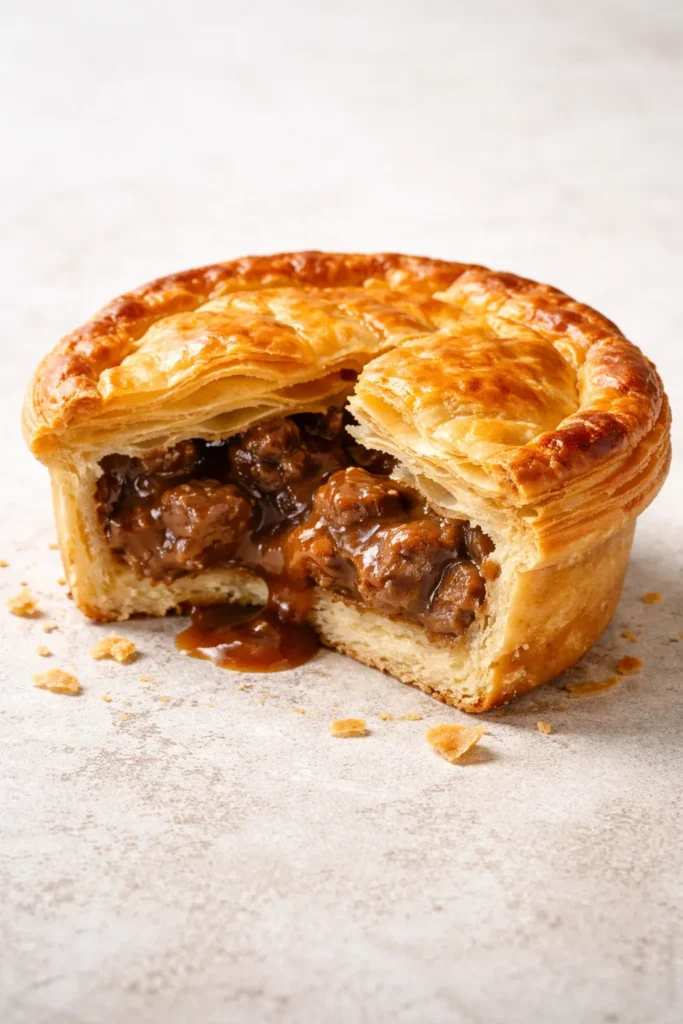
Before getting into the recipes, it’s worth explaining why authentic Australian meat pies use two different types of pastry — one for the base and one for the lid. This isn’t tradition for tradition’s sake. It’s genuinely the best approach.
Shortcrust pastry goes on the base and sides. It’s dense, sturdy, and holds its shape under the weight of a heavy, saucy filling. Crucially, it doesn’t collapse when you pick the pie up — and a proper Aussie pie is always eaten by hand. Shortcrust also blind bakes well, which is how you prevent the dreaded soggy bottom.
Puff pastry goes on top as the lid. Its job is entirely different — it’s all about texture and drama. As it bakes, the layers of butter-laminated dough puff up, separate, and turn shatteringly flaky and golden. That contrast between the firm base and the airy, crisp lid is what makes every bite interesting.
Shortcut vs. Scratch: What to Use
Making shortcrust pastry from scratch takes about five minutes in a food processor and gives noticeably better results — flakier, richer, and with more flavour. It’s genuinely worth doing. Puff pastry, on the other hand, is a multi-day project involving lamination and resting, and almost no home cook on earth would argue it’s worth making from scratch when frozen store-bought puff pastry performs beautifully.
In Australia, both come frozen in square sheets. If you’re in the United States or Canada, look for refrigerated pie crusts (the rolled-up Pillsbury style) for the base, and Pepperidge Farm puff pastry sheets for the lid — these work well in every recipe below.
1. Classic Chunky Chuck Beef Pie
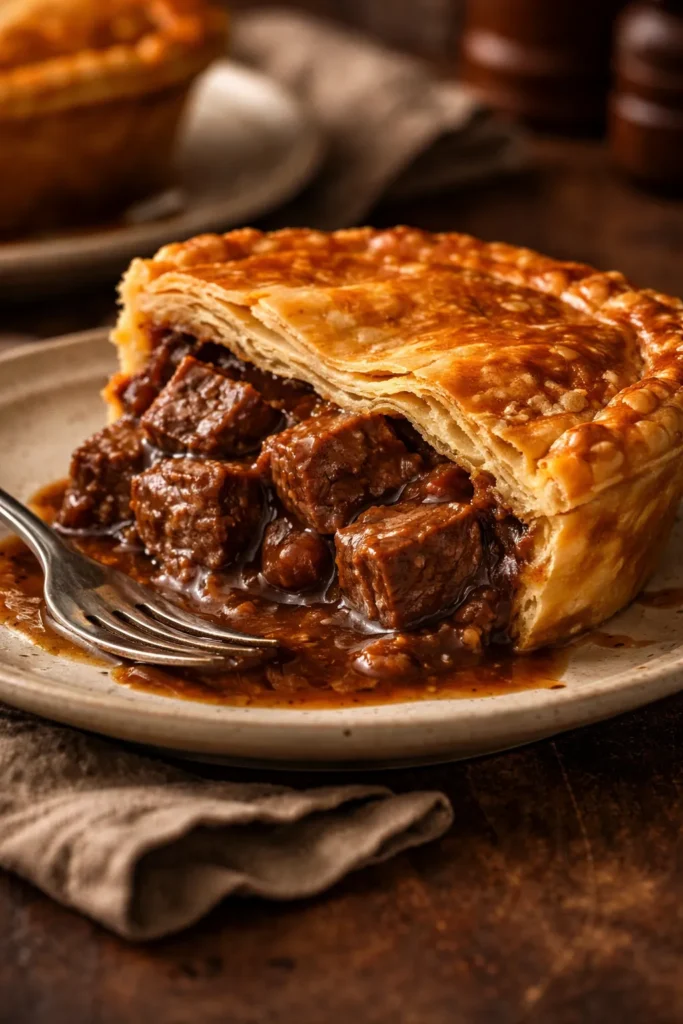
If there’s a pinnacle of the meat pie form, this is it. Thick cubes of chuck beef slow-braised in a deeply savoury red wine and beef stock gravy until they’re fall-apart tender — this is the chunky pie that Bourke Street Bakery in Sydney has built a reputation on, and it’s the benchmark every ambitious home cook should attempt at least once.
The key to this version’s extraordinary flavour is how aggressively you brown the beef. Don’t rush it. Brown in small batches in a very hot pan, getting deep mahogany colour on every surface of each cube. That caramelisation is the flavour foundation of the entire pie — skip it and the gravy will taste thin and disappointing regardless of how long you simmer it.
What You Need
For the Filling:
- 1.25 kg (2.75 lb) beef chuck, cut into 2.5 cm (1-inch) cubes
- 2–3 tablespoons olive oil
- 1 large onion, finely diced
- 4 garlic cloves, minced
- 5 tablespoons plain flour
- 315 ml (1¼ cups) low-sodium beef stock
- 750 ml (3 cups) dry red wine (merlot, shiraz, or cabernet sauvignon)
- 2 tablespoons tomato paste
- 1 teaspoon Worcestershire sauce
- 2 teaspoons coarsely ground black pepper
- 2 bay leaves
- ½ teaspoon salt
For the Pastry:
- 1.5 batches homemade shortcrust pastry (or 3 frozen shortcrust sheets, thawed)
- 3 frozen puff pastry sheets, just thawed
- 1 egg, lightly beaten
Why This Version Stands Above the Rest
The red wine does something to chuck beef over a long, slow simmer that beef stock alone simply cannot replicate. It adds body, colour, and a background richness that makes the gravy taste genuinely complex. Don’t worry about the alcohol — it cooks off completely over nearly three hours of simmering. What remains is just that layered, wine-forward depth.
Pro tip: Make the filling the night before and refrigerate it completely. The flavour deepens overnight, and cold filling is far easier to work with — it won’t make the shortcrust base go soggy during assembly.
- Serves 6 individual pies
- Prep Time: 45 minutes
- Cook Time: 3 hours (filling) + 50 minutes (pastry and baking)
- Difficulty: Intermediate — multiple components, but each step is straightforward
2. Old-School Beef Mince Pie
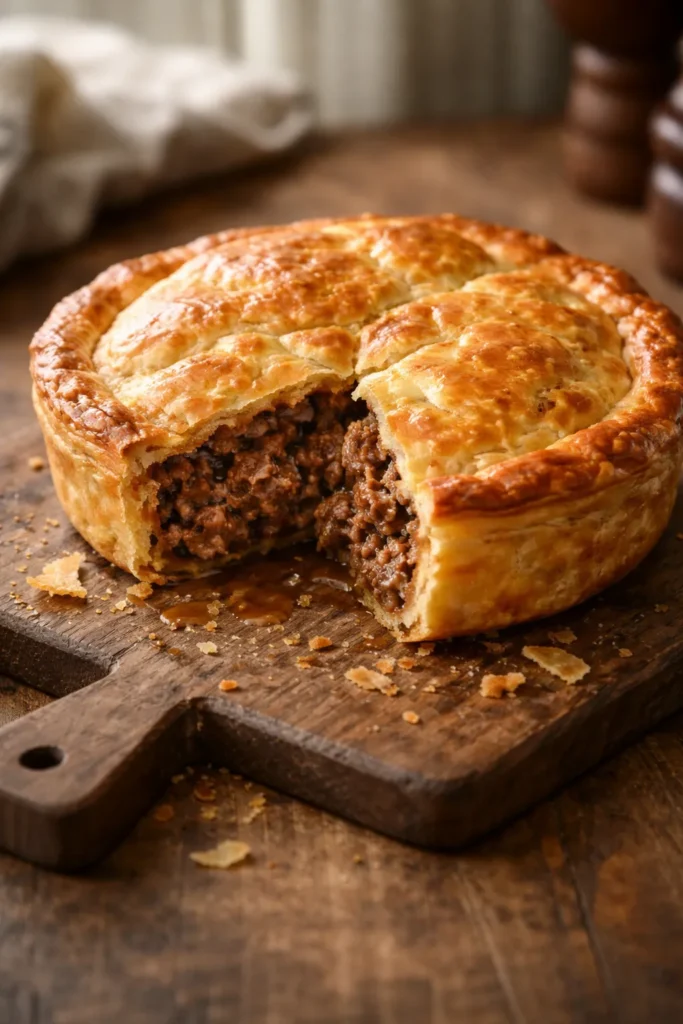
The chunky version might win on flavour complexity, but don’t underestimate the mince pie. This is what most Australians grew up eating — the filling you’d find in a corner shop warmer or a suburban bakery pie, and the version that triggers instant nostalgia for anyone who’s been away from Australia for a while.
Getting great flavour from beef mince requires a different approach than chunky beef. Because ground beef doesn’t brown in the same dramatic way that cubed pieces do, you need to build the flavour through other means: a beef stock cube for concentrated depth, a splash of dark soy sauce for colour and umami, Worcestershire sauce for that savoury tang, and enough coarsely ground black pepper to give the gravy some heat.
What You Need
For the Filling:
- 1.3 kg (2.6 lb) lean beef mince (ground beef)
- 1 large onion, finely diced
- 4 garlic cloves, minced
- 5 tablespoons plain flour
- 500 ml (2 cups) beef stock
- 1 beef stock cube, crumbled
- 2 tablespoons tomato paste
- 2 teaspoons Worcestershire sauce
- 1 teaspoon dark soy sauce (for colour and depth)
- 2 teaspoons coarsely ground black pepper
- 2 bay leaves
- Olive oil for cooking
The Dark Soy Sauce Secret
It sounds like an unusual addition to an Australian pie, but a small amount of dark soy sauce does something remarkable to a mince filling: it gives the gravy a rich, appetising brown colour (mince gravy without it tends to look pale and unappetising) and adds a savoury depth that doesn’t taste remotely Asian. It’s the same principle behind adding a splash of Worcestershire sauce — you’re not tasting the individual ingredient, you’re tasting what it does to the whole.
- Serves 6 individual pies
- Prep Time: 20 minutes
- Cook Time: 1 hour 45 minutes
- Difficulty: Beginner — simpler than the chunky version, forgiving, and faster
3. Beef and Guinness Pie
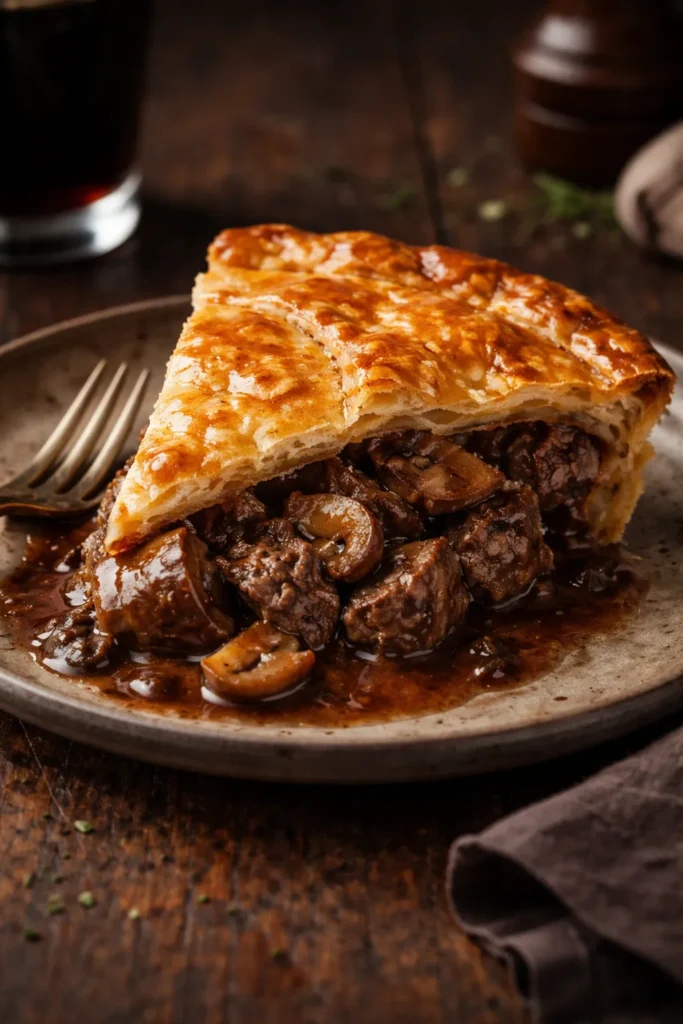
Guinness and beef were made for each other. The stout adds a dark, malty bitterness that balances the richness of slow-cooked chuck in a way that red wine can’t quite match — it’s earthier, denser, and produces a gravy that’s almost black-brown in colour and tastes like it’s been cooking for days.
This is the version you make when you want to genuinely impress people. It’s the pub pie elevated to something worth talking about — the kind of recipe that makes guests ask for it again before they’ve even finished the first one. Adding mushrooms to this filling is, in the opinion of most people who try it, not optional: they add texture, absorb the stout-rich gravy beautifully, and make the filling feel substantial without being heavy.
What You Need
For the Filling:
- 1 kg (2 lb) beef chuck or brisket, cut into 5 cm (2-inch) chunks
- 60 ml (¼ cup) olive oil
- 2 brown onions, thickly sliced
- 3 garlic cloves, finely chopped
- 250 ml (1 cup) Guinness or other stout
- 500 ml (2 cups) beef stock
- 5 thyme sprigs
- 2 bay leaves
- 500 g (1 lb) white or portobello mushrooms, thickly sliced
- 2–3 tablespoons cornflour mixed with 3 tablespoons water (to thicken)
- Sea salt and freshly cracked black pepper
Building the Stout Gravy
Once you add the Guinness to the hot pan after browning the beef, use a wooden spoon to scrape up all the caramelised bits stuck to the bottom — this is called deglazing, and those sticky, dark bits are concentrated flavour. Don’t skip this step. Every bit of caramelisation that dissolves into the stout becomes part of the gravy.
- Serves 10–12 individual pies (or 2 large family pies)
- Prep Time: 30 minutes
- Cook Time: 2.5 to 3 hours
- Difficulty: Intermediate — longer cook time but deeply rewarding results
4. Bacon and Beef Mince Pie
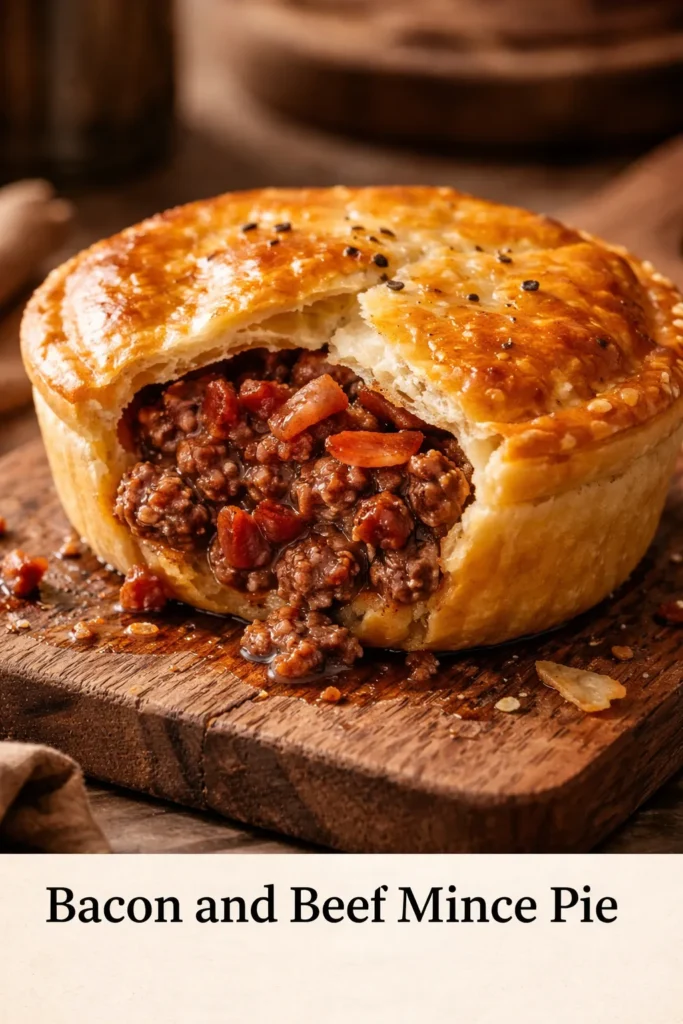
Adding bacon to a meat pie filling sounds almost too obvious — but most recipes don’t include it, which makes this version a genuine standout. The bacon brings smokiness, saltiness, and fat, all of which enrich both the filling texture and the gravy flavour in ways that mince alone simply can’t achieve.
The technique here matters. Cook the onion, garlic, and bacon together first until the bacon is lightly crispy and the fat has rendered out into the pan. That bacon fat becomes your cooking medium for the mince — and it seasons everything that follows. The result is a filling with noticeably more layered, complex flavour than a standard mince pie.
What You Need
For the Filling:
- 500 g (1 lb) beef mince (ground beef)
- 1 brown onion, finely chopped
- 2 garlic cloves, finely chopped
- 5 rashers (strips) of bacon, thinly sliced
- 3 tablespoons Worcestershire sauce
- 1 tablespoon barbecue sauce
- 1 teaspoon curry powder
- ½ teaspoon freshly grated nutmeg
- 250 ml (1 cup) beef stock
- 1 tablespoon plain flour
- Salt and freshly cracked black pepper
- Optional: sesame seeds or poppy seeds to top the puff pastry lid
The Curry Powder Question
A small amount of curry powder in a meat pie filling sounds controversial to purists, but it genuinely works. It doesn’t make the pie taste like a curry — at 1 teaspoon across a large batch of filling, it adds a background warmth and subtle spice complexity that’s hard to identify but very easy to appreciate. Skip it if you prefer strictly traditional, but try it at least once before making that decision.
- Serves 20 or more party-size pies (or 6 individual pies)
- Prep Time: 40 minutes
- Cook Time: 35 minutes
- Difficulty: Beginner — the simplest filling method in this list
5. Vegetable-Loaded Mince Pie
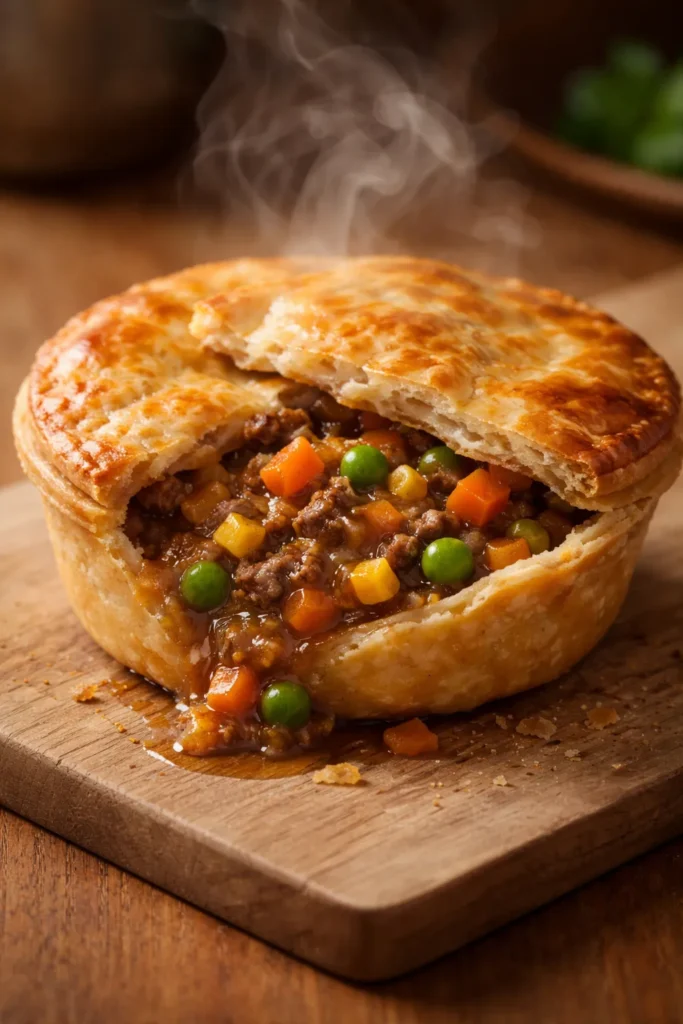
Not every great meat pie is purely about the meat. Adding finely diced carrot, peas, corn, and celery to a beef mince filling creates a version that’s more substantial, more nutritious, and — honestly — more interesting to eat. The vegetables add textural contrast, break up the density of the filling, and soak up the gravy in a way that makes every bite slightly different.
This is also the version that tends to work best for families with younger kids. The vegetables are hidden in the filling and take on the flavour of the beef and gravy, which makes them far less objectionable to picky eaters than vegetables served on the side. One cup of frozen peas and a finely diced carrot added to a standard mince filling make a measurable difference to both the nutrition and the eating experience.
What You Need
For the Filling:
- 750 g (1.5 lb) lean beef mince
- 1 large onion, finely diced
- 2 garlic cloves, crushed
- 1 medium carrot, finely diced
- 1 cup frozen peas
- 1 cup corn kernels (frozen or tinned, drained)
- 400 g (14 oz) diced tinned tomatoes
- 2 tablespoons tomato paste
- ½ cup beef stock
- 1.5 tablespoons gravy powder
- 2 tablespoons olive oil
- Salt and pepper to taste
Keeping the Vegetables Distinct
Dice the carrot small enough that it cooks through completely during the filling’s simmering time — about 5 mm cubes. Add the peas and corn in the last five minutes of cooking so they hold their shape and don’t dissolve into the gravy. If you want to add mushrooms, stir them in three minutes before the filling finishes cooking; they need less time than you’d think, and overdone mushrooms turn rubbery and flavourless.
- Serves 12 individual pies
- Prep Time: 15 minutes
- Cook Time: 40 minutes
- Difficulty: Beginner — fast, flexible, and forgiving
6. Family-Size Sharing Pie
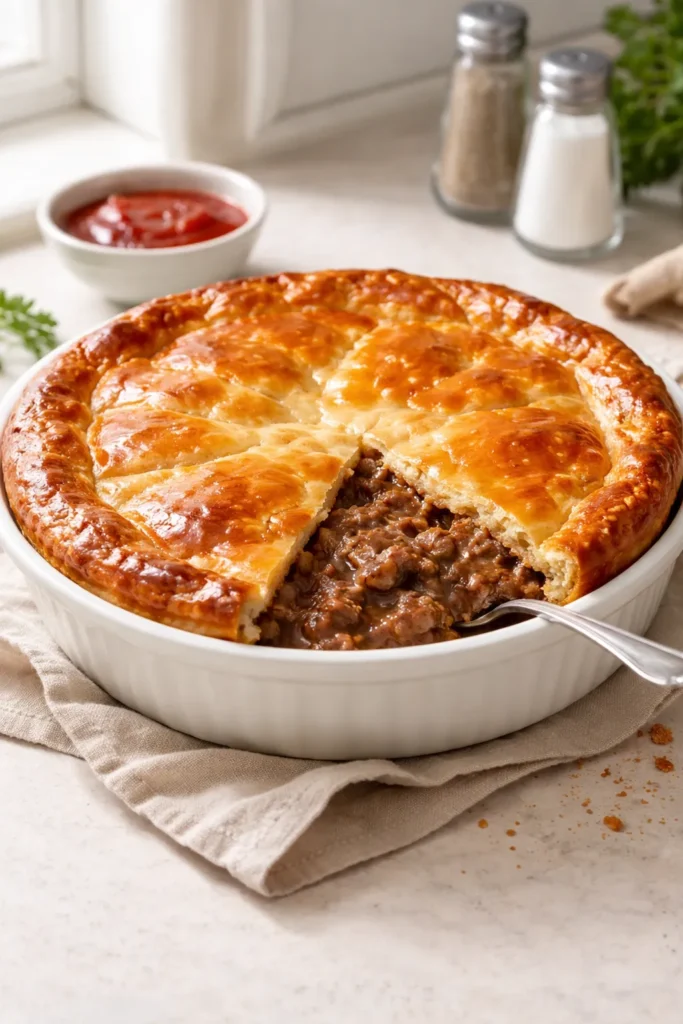
Everything about this version is scaled up. Instead of six individual hand-held pies, this recipe makes one large pie baked in a 30 cm (12-inch) pie dish — the format that makes sense when you’re feeding a crowd, when individual pie tins aren’t available, or when you just want the simplicity of one large pie to slice and serve.
The filling is identical to the classic chunky chuck recipe (Recipe 1), but the larger format changes both the pastry-to-filling ratio and the way you eat it. This is a knife-and-fork situation — something that would earn you a raised eyebrow in Australia if you were eating an individual pie, but is perfectly sensible with a family-size version. Serve it with mashed potatoes, mushy peas, and a generous squirt of tomato sauce.
Adapting Individual Pie Recipes to Family Size
The conversion is simpler than you’d think. Use the same filling quantities as Recipe 1 — you’ll likely have more filling than fits in a single large pie dish, which means leftovers that can be frozen or served alongside as a stew. For the pastry: one full sheet of shortcrust lines the base of a standard deep-dish pie plate, and one full sheet of puff pastry covers the top. Blind bake the shortcrust base for 15 minutes before filling.
Why the Shortcrust Base Still Matters in a Large Pie
Some large pie recipes use puff pastry for the entire pie — base and lid — to save time. The problem is that the base inevitably goes soggy under the weight and moisture of the filling. Shortcrust on the base, blind-baked until lightly golden, is the only way to guarantee structural integrity. It takes an extra 15 minutes and the result is incomparably better.
- Serves 8–10
- Prep Time: 45 minutes (plus filling made ahead)
- Cook Time: 50 minutes (including blind bake)
- Difficulty: Intermediate
7. Curry-Spiced Beef Mince Pie
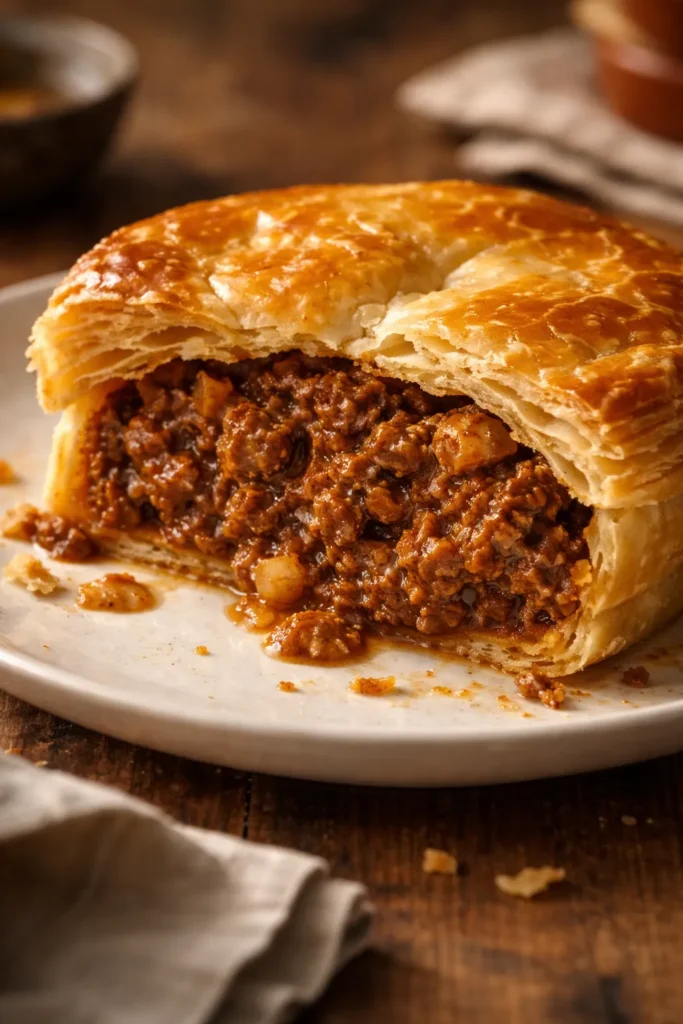
This version leans into the curry powder addition found in certain classic Australian bakery recipes — not as a hint, but as a genuine flavour driver. Doubling the curry powder to two teaspoons and pairing it with a squeeze of tomato paste, Worcestershire sauce, and a proper beef stock creates a filling with real warmth and aromatic depth. It’s distinctly different from a plain mince pie, but still unmistakably Aussie.
Some of the most beloved suburban pie shop recipes in Australia have always included curry powder as a not-quite-secret ingredient. It’s the thing that makes you eat a pie and think “there’s something in here that I love but can’t quite place.” That’s the curry doing its work — providing background complexity without announcing itself.
Building the Spiced Filling
- 500 g (1 lb) beef mince
- 1 onion, finely diced
- 3 garlic cloves, minced
- 2 teaspoons mild curry powder
- ½ teaspoon ground cumin
- ¼ teaspoon nutmeg
- 2 tablespoons tomato paste
- 2 tablespoons Worcestershire sauce
- 1 tablespoon barbecue sauce
- 300 ml (1¼ cups) beef stock
- 1.5 tablespoons plain flour
- Salt and black pepper
- 1 tablespoon olive oil
How to Balance the Spice Level
Use mild curry powder for a subtle warmth that enhances without dominating. Medium or hot curry powder will push the filling into actual curry territory, which some people love but others find jarring in a pie context. If you want more heat without more curry flavour, add ¼ teaspoon of cayenne pepper separately — it adds heat without changing the aromatic profile.
- Serves 6 individual pies
- Prep Time: 20 minutes
- Cook Time: 35 minutes
- Difficulty: Beginner — fast filling, maximum flavour payoff
8. Mini Party Meat Pies
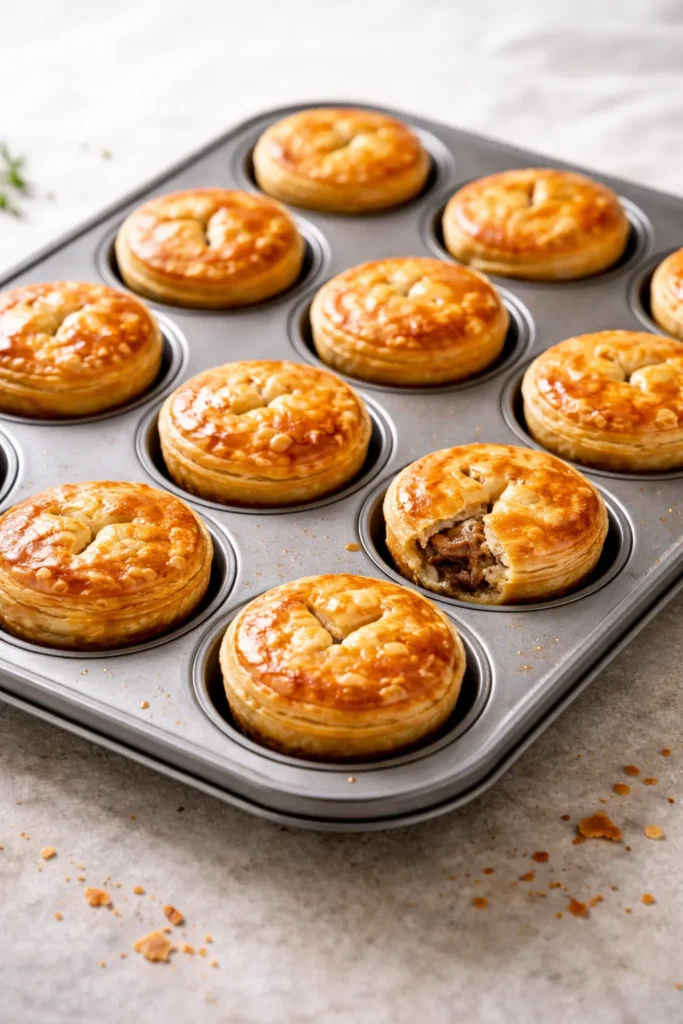
These are the crowd pleasers — small, two-bite pies made in a standard muffin tin, perfect for parties, game days, after-school snacks, or any situation where hand-held food is needed in quantity. They’re every bit as satisfying as a full-sized pie; the ratio of golden crust to rich filling is actually better at this size because you get more pastry per bite.
Party pies are traditionally made with a beef mince filling (the faster-cooking option suits the smaller size), but any of the mince fillings in this list work well. The only adjustment you need to make is ensuring the filling is not too chunky — pieces should be small enough to fit neatly into a muffin tin cup without creating air gaps.
What You Need
For the Filling:
- 500 g (1 lb) beef mince
- 1 onion, finely diced
- 2 garlic cloves, minced
- ¾ cup water
- ¼ cup tomato sauce (ketchup)
- 2 teaspoons Worcestershire sauce
- 2 beef stock cubes, crumbled
- ½ teaspoon dried oregano
- ¼ teaspoon black pepper
- ¼ cup cornflour mixed with ¼ cup cold water
For Assembly:
- Shortcrust pastry sheets (for bases)
- Puff pastry sheets (for lids)
- 1 egg, beaten (for egg wash)
Getting the Size Right
Use a 4-inch (10 cm) round cutter for the shortcrust bases and a 3-inch (7.5 cm) round cutter for the puff pastry lids. Press the shortcrust rounds gently into each muffin tin cup without stretching the pastry — stretching causes shrinkage during baking. Fill each cup about ¾ full with cooled filling, press the puff pastry lid on top, seal the edges by pressing with a finger or fork, brush with egg wash, and cut a small steam vent in the centre.
Bake at 200°C (400°F) for 15–20 minutes until the lids are deep golden and puffed. Let them cool for 10 minutes in the tin before removing — they firm up significantly as they cool and are much easier to handle after that brief rest.
- Makes 12 party pies
- Prep Time: 30 minutes
- Cook Time: 25 minutes
- Difficulty: Beginner — straightforward assembly, crowd-pleasing results
Tips for Flaky Pastry Every Single Time
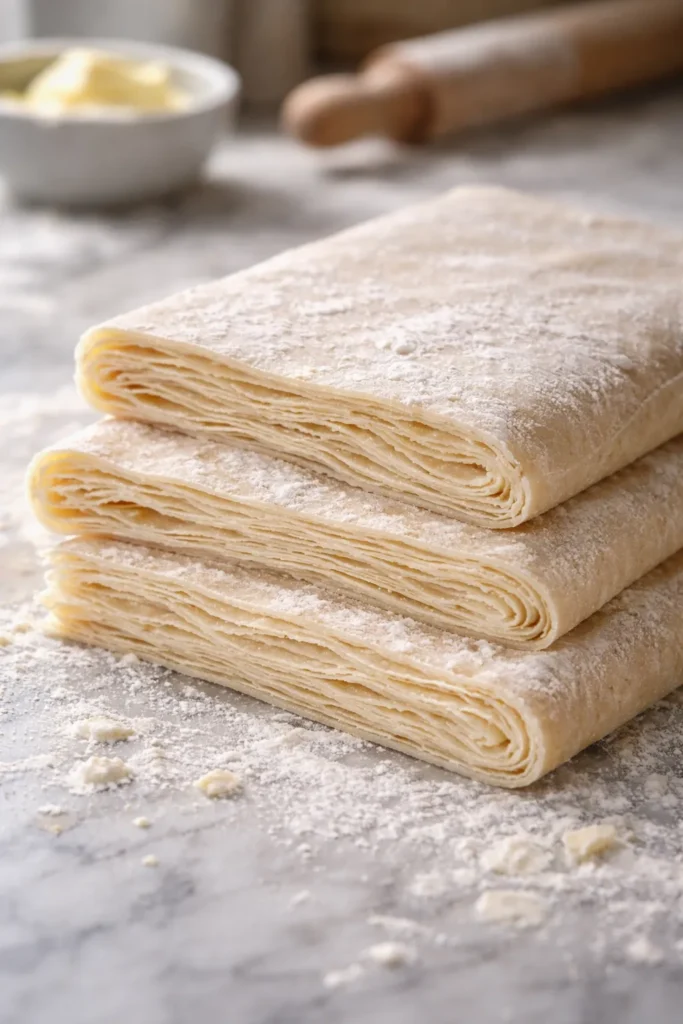
Pastry is where most homemade meat pie attempts go wrong, and the fixes are almost always simple. The biggest enemy of good pastry is warmth — warm pastry melts the butter before it reaches the oven, which means the fat can’t create steam during baking, which is what produces those distinct flaky layers in puff pastry and the crumbly texture in shortcrust.
Keep everything cold. When assembling pies, work quickly. If the puff pastry starts to feel soft and warm to the touch, slide it (still on the baking sheet) into the refrigerator for 15 minutes before baking. Cold pastry going into a hot oven produces the best results — the butter melts fast, creates steam immediately, and produces dramatic puffing.
Blind Baking: Why It’s Non-Negotiable
Blind baking the shortcrust base before adding the filling is a step that some recipes say you can skip. Don’t skip it. The filling in a meat pie is wet, saucy, and heavy — a raw shortcrust base will absorb moisture from the filling before it has a chance to cook through, resulting in a pale, damp, gluey base that sticks to the tin and tastes doughy.
To blind bake: line the raw shortcrust with baking paper, fill with pie weights (or dry rice or dried beans — these work just as well), and bake at 180°C (350°F) for 20 minutes. Remove the weights and paper, then return the shell to the oven for a further 5 minutes until the base is lightly golden and dry to the touch.
Egg Wash for Maximum Colour
A proper egg wash — one egg lightly beaten with a splash of milk — applied to the puff pastry lid before baking makes a significant difference to the final colour. Egg gives a deep, glossy, amber-brown result that looks genuinely professional. Milk alone produces a paler, more matte finish. Water produces almost nothing. Brush the egg wash in a thin, even layer, and cut a small steam vent in the centre of each lid so the filling doesn’t build up pressure and crack the pastry.
Serving Suggestions and Classic Accompaniments
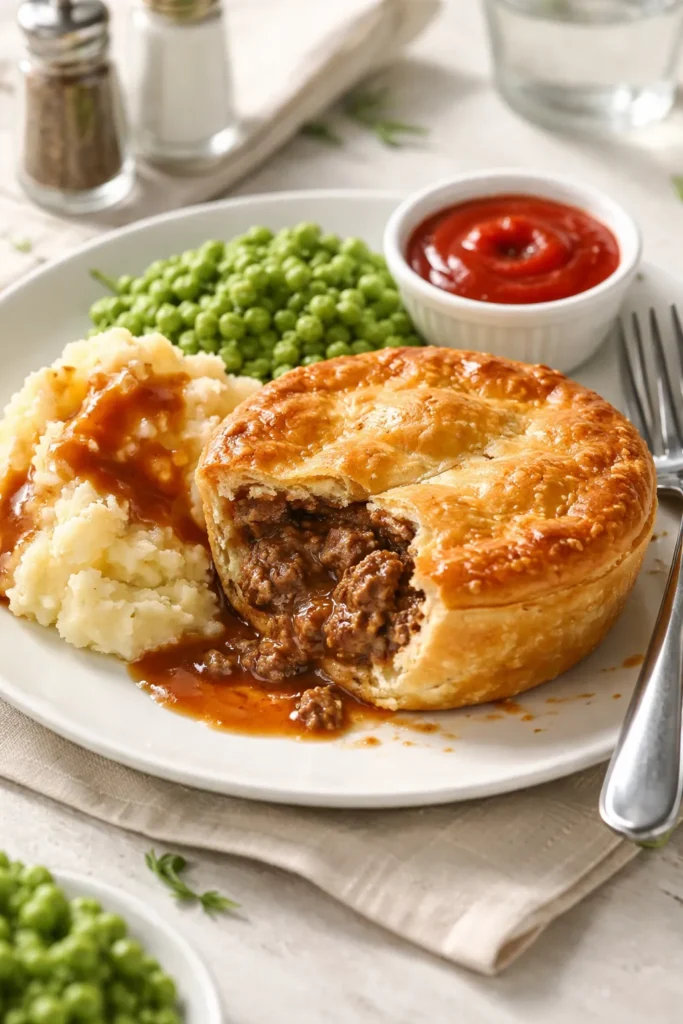
No serious discussion of Australian meat pies is complete without acknowledging tomato sauce — ketchup, if you’re outside Australia. In Australia, you don’t put tomato sauce on a meat pie; you load it on, dragged across the top in a generous, unapologetic smear. The sharpness and sweetness of the tomato cuts through the richness of the beef filling and the buttery pastry in a way that makes the whole experience click into place.
Beyond tomato sauce, here’s what works well alongside meat pies:
- Mushy peas — the British-style version, soft and lightly seasoned, served inside the pie under the lid or spooned alongside
- Mashed potato — creamy, buttery, and good at catching the gravy that inevitably escapes when you bite in
- Chips (fries) — the footy ground classic, eaten alongside with more tomato sauce
- A simple green salad — if you want to pretend you’re making this a balanced meal
The traditional Australian eat-by-hand method is, of course, the correct approach for individual pies. Knife and fork is acceptable for family-sized pies and for anyone who genuinely cannot handle gravy running down their wrist. For everyone else: pick it up, take a big bite, and enjoy the chaos.
Storage, Freezing, and Reheating
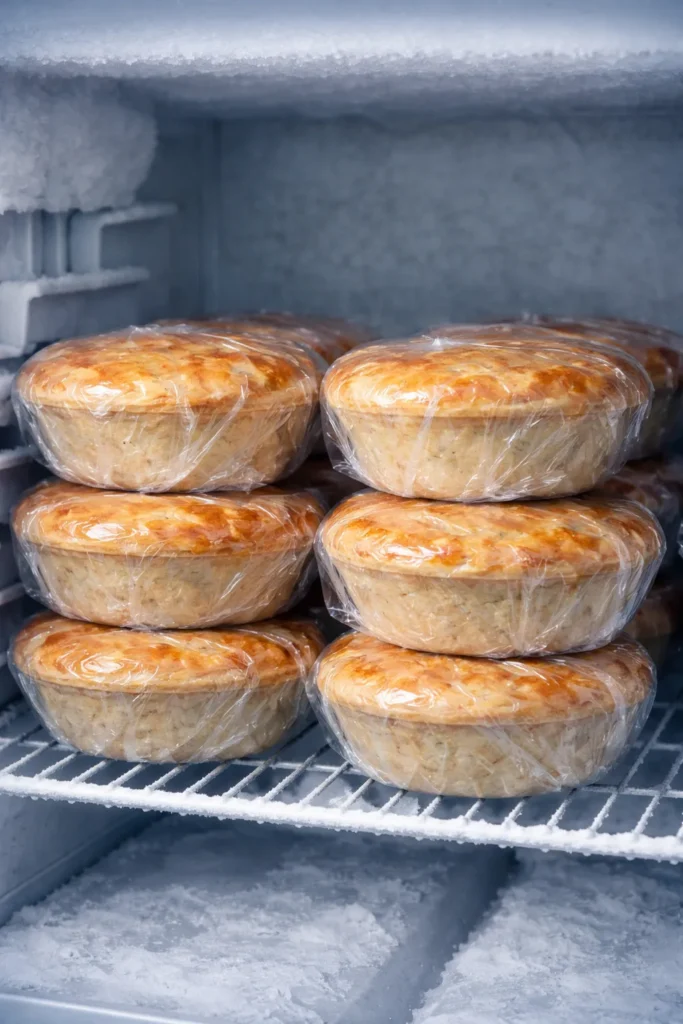
One of the underrated advantages of homemade meat pies is how well they freeze. A batch of six individual pies takes a full day to make properly, but the freezer means that effort pays dividends for months.
Refrigerating cooked pies: Cooked pies keep well in the refrigerator for up to five days. To reheat, give each pie 60–90 seconds in the microwave to warm the filling through, then transfer to a 180°C (350°F) oven for five minutes to re-crisp the puff pastry lid. Never reheat solely in the microwave — the pastry will turn soft and soggy.
Freezing cooked pies: Wrap each cooled pie individually in plastic wrap, then place in a zip-lock freezer bag. They’ll keep for up to three months. Thaw overnight in the refrigerator, then reheat in a 180°C (350°F) oven for 20 minutes until the centre is completely hot.
Freezing uncooked assembled pies: This is the best method if you want to make-ahead without compromising pastry texture. Assemble the pies completely (shortcrust base blind-baked, filling added, puff pastry lid pressed on and egg-washed), then freeze them in the pie tins. Once frozen solid, pop them out of the tins, wrap individually, and store in freezer bags. Bake from frozen at 180°C (350°F) for 35–40 minutes, adding 10 minutes to the standard bake time.
Filling only: The braised beef or mince filling can be made and refrigerated for up to three days before assembling the pies, or frozen for up to three months. Making the filling in advance is genuinely the smartest approach — the flavour improves significantly overnight, and cold filling is far easier to work with during assembly.
Final Thoughts

Australian meat pies are one of those foods that reward the effort put into them in direct proportion. A quickly assembled mince pie made with shortcut pastry and store-bought stock is still a good pie. A slow-braised chunky beef pie with properly blind-baked shortcrust and cold puff pastry is a genuinely great one. The eight recipes here cover the full range — from the fast and accessible to the deeply invested.
What they all share is that combination of flaky, golden puff pastry over a rich, saucy filling that makes the Aussie meat pie one of the most satisfying things to eat with your hands. Whether you go the mince route for speed or commit to a three-hour braise for the weekend version, the pastry technique stays the same: keep it cold, blind bake the base, and don’t hold back on the egg wash.
And when they come out of the oven — golden, puffed, smelling of browned beef and buttery pastry — do what every Australian does. Load them up with tomato sauce, burn the roof of your mouth on the first bite, and have absolutely no regrets about it.