Picture yourself relaxing in your backyard, surrounded by the graceful silhouettes of swaying palm fronds that instantly transport you to a tropical paradise. Palm trees have an almost magical ability to transform any landscape into an exotic retreat, whether they’re standing tall in your garden or adding a touch of the tropics to your living room. But here’s what many people don’t realize: despite their reputation as low-maintenance plants, palm trees have specific care requirements that, when met, can mean the difference between a thriving, lush specimen and a struggling, yellowing eyesore.
The good news? You don’t need to be a master gardener to keep your palm trees healthy and beautiful for years to come. With over 2,600 varieties of palms in the world, these iconic plants have adapted to environments ranging from scorching deserts to humid rainforests, which means there’s likely a perfect palm for your specific situation. Whether you’ve just brought home your first palm tree or you’re looking to revive an established one, understanding the fundamentals of palm tree care will set you on the path to success. In this comprehensive guide, you’ll discover everything you need to know about watering, fertilizing, pruning, and protecting your palm trees from common threats—all broken down into actionable steps that anyone can follow.
Table of Contents
- Understanding Palm Trees: Why Proper Care Matters
- Selecting the Right Palm Tree for Your Location
- Climate and Hardiness Zone Considerations
- Indoor vs. Outdoor Palm Selection
- Essential Watering Requirements for Palm Trees
- Watering Newly Planted Palms
- Watering Established Palms
- Container Palm Watering Guidelines
- Palm Tree Fertilization: Feeding Your Trees Right
- Choosing the Best Palm Fertilizer
- When and How to Apply Fertilizer
- Proper Pruning Techniques for Healthy Palms
- When to Prune Palm Fronds
- How to Safely Prune Your Palm Tree
- Soil and Mulching Best Practices
- Ideal Soil Conditions
- Mulching Benefits and Application
- Protecting Palm Trees from Pests and Diseases
- Common Palm Tree Pests
- Recognizing and Treating Palm Diseases
- Cold Weather Protection and Winter Care
- Indoor Palm Tree Care Essentials
- Light and Humidity Requirements
- Potting and Repotting Guidelines
- Key Takeaways: Your Palm Tree Care Checklist
Understanding Palm Trees: Why Proper Care Matters
Before diving into specific care techniques, it’s essential to understand what makes palm trees unique and why they deserve specialized attention. This foundational knowledge will help you make better decisions throughout your palm care journey.
Palm trees may look like trees, but botanically speaking, they’re more closely related to grasses than to traditional hardwood trees. Unlike true trees, palms don’t undergo secondary growth—the process that creates annual rings and thickens bark over time. Instead, their trunks are fibrous and lack true bark, which means any damage to the trunk can have lasting consequences. This unique structure also explains why palms cannot regenerate their crowns if the growing point (called the bud or heart) is damaged.
Key characteristics that set palms apart include:
- Single growing point: Palms grow from a single terminal bud at the top of the trunk, making crown protection critical
- Fibrous root system: Palm roots spread horizontally rather than growing deep taproots, affecting how you water and fertilize
- Frond lifecycle: Palm fronds naturally yellow and die as new ones emerge, which is normal and not necessarily a sign of problems
- Drought adaptation: Many palms have evolved to tolerate dry conditions, though this doesn’t mean they thrive without water
Proper palm tree care ensures your trees maintain their stunning appearance while avoiding common problems like nutrient deficiencies, pest infestations, and disease. When you understand that a palm’s health depends largely on its growing point and root system, you’ll appreciate why practices like proper watering depth, correct fertilizer application, and careful pruning are so crucial to long-term success.
Selecting the Right Palm Tree for Your Location
Choosing the appropriate palm species for your specific environment is the single most important decision you’ll make in your palm care journey. A palm that’s well-suited to your climate and growing conditions will thrive with minimal intervention, while a poorly matched palm will struggle regardless of how much care you provide.
Climate and Hardiness Zone Considerations
Palm trees are most commonly associated with warm, tropical climates, but many species can tolerate surprisingly cold temperatures. Understanding your USDA hardiness zone is the first step in selecting a palm that will survive and flourish in your area.
Cold-hardy palms for temperate regions (Zones 7-8) include:
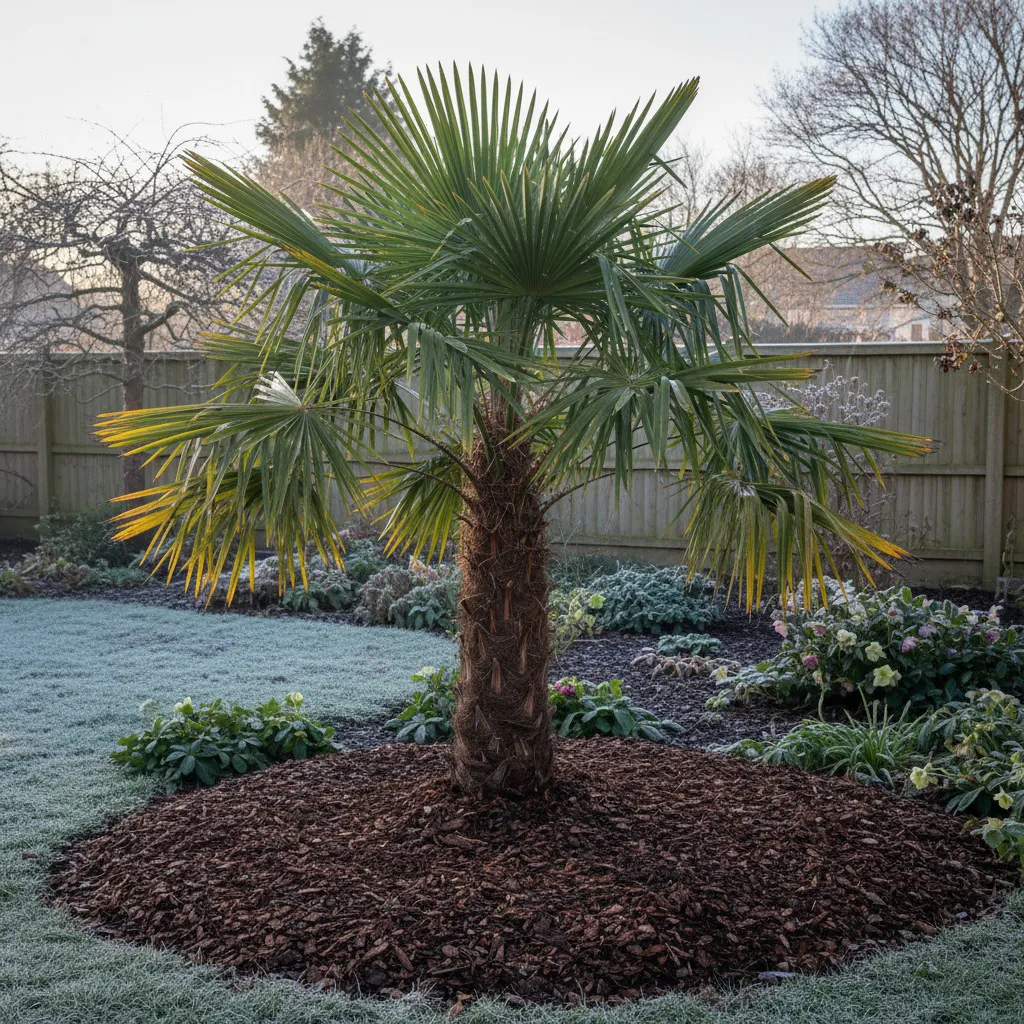
- Windmill Palm: Tolerates temperatures down to 5°F (-15°C) and features a distinctive hairy trunk
- Needle Palm: One of the hardiest palms, surviving temperatures as low as -10°F (-23°C)
- Cabbage Palm (Sabal Palmetto): Native to the southeastern United States and tolerant of temperatures to 15°F (-9°C)
- Chinese Fan Palm: Hardy to Zone 8 with protection, making it suitable for many southern and coastal regions
Tropical and subtropical palms (Zones 9-11) offer more variety:
- Royal Palm: Majestic specimens that can reach 50+ feet but require consistently warm temperatures
- Coconut Palm: The iconic tropical palm that needs frost-free conditions year-round
- Queen Palm: Popular in California and Florida for its graceful, feathery fronds
- Date Palm: Excellent for hot, dry climates and commercially valuable for fruit production
When selecting a palm, also consider the mature size of the tree. Some palms can soar to heights of 80 feet or more, while others remain compact at 5-10 feet. Always research the specific species’ growth rate, ultimate height, and spread to ensure it will fit your space appropriately.
Indoor vs. Outdoor Palm Selection
Not all palms make suitable houseplants, and not all outdoor palms can transition successfully indoors. The key factors for indoor palm selection include light tolerance, humidity requirements, and growth rate.
Top palms for indoor cultivation:
- Parlor Palm (Chamaedorea elegans): Thrives in low to medium light and stays compact
- Kentia Palm: Tolerates lower light conditions and typical household humidity
- Bamboo Palm: Shade-tolerant and excellent for filtering indoor air
- Areca Palm: Requires brighter light but adds dramatic tropical flair to any room
Indoor palms generally grow more slowly than their outdoor counterparts because container cultivation naturally limits root expansion. This can actually be advantageous for houseplant enthusiasts, as it reduces the frequency of repotting and keeps plants at manageable sizes. However, indoor palms have higher humidity requirements than many homes naturally provide, particularly during winter when heating systems dry the air.
Essential Watering Requirements for Palm Trees
Water is the lifeblood of healthy palm trees, but getting the balance right requires understanding that different life stages and growing conditions demand different approaches. Overwatering and underwatering are both common problems that can seriously damage or kill palm trees.
Watering Newly Planted Palms
Newly planted palm trees have the greatest water needs because their root systems haven’t yet established in the surrounding soil. During this critical period, consistent moisture is essential for root development and overall plant survival.
Follow this watering schedule for newly planted palms:
-
Immediately after planting: Saturate the root ball completely, ensuring water penetrates deeply into the surrounding soil. This initial watering settles the soil around the roots and eliminates air pockets that can cause root desiccation. Apply enough water to moisten the soil to a depth of at least 12-18 inches, which encourages roots to grow downward rather than staying near the surface where they’re vulnerable to drought stress.

-
First two weeks: Water daily, especially during hot, dry weather. The root ball of a newly transplanted palm can dry out quickly because it hasn’t yet integrated with the surrounding soil. Deep, thorough watering is more beneficial than frequent light watering, as it promotes the development of a strong, deep root system that will serve the palm well throughout its life.
-
Weeks three through twelve: Reduce watering to every other day or three to four times weekly, depending on your local weather conditions. Continue monitoring the soil moisture by inserting your finger several inches into the ground near the root ball. If the soil feels dry at this depth, it’s time to water again.
-
After the first year: Your palm tree should be well-established and can transition to the watering schedule for mature palms. However, continue monitoring during extended dry periods or heat waves, as even established palms benefit from supplemental irrigation during environmental stress.
Watering Established Palms
Once established, most palm species become surprisingly drought-tolerant and can survive on rainfall alone in many regions. However, “survive” and “thrive” are two different things—regular irrigation during dry periods promotes healthier growth and more attractive foliage.
Best practices for watering established outdoor palms:
- Frequency: Water once weekly during the growing season when rainfall is insufficient
- Depth: Apply 1.5 to 2.5 gallons per watering, ensuring moisture reaches the deeper roots
- Timing: Water in the early morning to reduce evaporation and allow foliage to dry before evening
- Seasonal adjustment: Reduce watering during winter dormancy to once every three to four weeks
The key indicator for watering established palms is soil moisture, not a rigid calendar schedule. Insert your finger or a moisture meter into the soil near the root zone. If the top 2-3 inches are dry, it’s time to water. Sandy soils drain quickly and may require more frequent irrigation, while clay soils retain moisture longer and need less frequent watering.
Container Palm Watering Guidelines
Palms growing in containers have different water requirements than those planted in the ground because their root systems are confined to a limited soil volume that can dry out quickly, especially in warm weather or when exposed to wind.
Tips for watering container palms effectively:
- Check moisture regularly: Stick your finger into the potting mix; if the top 3-4 inches are dry, water thoroughly
- Water deeply: Apply water until it flows freely from the drainage holes, ensuring the entire root ball is moistened
- Never let pots sit in water: Empty saucers after watering to prevent root rot
- Adjust for pot material: Unglazed terra cotta pots dry out faster than plastic or glazed ceramic containers
- Monitor indoor heating effects: Indoor palms near heating vents may need more frequent watering during winter
Pro Tip: Container palms often need daily watering during hot summer months when placed outdoors. Set a reminder on your phone or establish a routine check to ensure your palm doesn’t suffer from drought stress.
Palm Tree Fertilization: Feeding Your Trees Right
Proper fertilization addresses the nutritional needs that soil alone often cannot meet, particularly in regions with sandy or nutrient-poor soils. Palm trees have specific nutrient requirements that differ from typical landscape plants, making specialized palm fertilizer essential for optimal health.
Choosing the Best Palm Fertilizer
Not all fertilizers are created equal when it comes to palm nutrition. Palms are particularly sensitive to deficiencies in potassium, magnesium, and certain micronutrients, which can cause distinctive symptoms like yellowing fronds, necrotic spotting, and frizzled new growth.
What to look for in a quality palm fertilizer:
- NPK ratio of 8-2-12: This formulation provides the ideal balance of nitrogen (N), phosphorus (P), and potassium (K) for palm health
- Magnesium content: Look for +4 Mg on the label, as magnesium deficiency is common in palms
- Controlled-release formulation: Ensures nutrients are released gradually over time rather than washing away with the first rain
- Complete micronutrients: Including manganese, iron, zinc, copper, and boron in water-soluble forms (except boron)
- “Palm special” labeling: Products specifically formulated for palms contain the correct nutrient ratios
Signs of common nutrient deficiencies to watch for:
- Nitrogen deficiency: Uniform yellowing of all leaves, starting with older fronds
- Potassium deficiency: Orange or yellow spotting on older fronds with necrotic (dead) leaf margins
- Magnesium deficiency: Yellow bands along the edges of older leaves while the center remains green
- Manganese deficiency: New fronds emerge stunted, frizzled, or with interveinal chlorosis (yellow tissue between green veins)
When and How to Apply Fertilizer
Timing and application technique significantly impact how effectively your palm absorbs nutrients. Improper fertilization can actually harm your palm trees, causing root burn or creating nutrient imbalances.
Optimal fertilization schedule:
-
First application: Apply in early spring (around April) when palms begin their active growing season. Spread the fertilizer evenly under the palm’s canopy, extending slightly beyond the drip line where feeder roots are most active. Avoid piling fertilizer against the trunk, as this can cause chemical burns to the sensitive trunk tissue.
-
Subsequent applications: Apply three to four additional times throughout the growing season, spacing applications evenly through early fall (September or October). Each application should follow the recommended rate on the product label, typically 1.5 pounds per 100 square feet of canopy area.
-
Winter rest period: Stop fertilizing after early fall to prevent stimulating tender new growth that could be damaged by cold temperatures. Palms go dormant during winter and don’t require nutritional supplementation during this period.
Application tips for best results:
- Water the soil before applying granular fertilizer to reduce the risk of root burn
- Scratch fertilizer into mulch layers so it contacts the soil surface
- Water thoroughly after application to begin the nutrient release process
- For container palms, follow package directions carefully and reduce dosage if recommended
Proper Pruning Techniques for Healthy Palms
Pruning is one of the most misunderstood aspects of palm tree care. Many well-intentioned gardeners actually harm their palms through improper or excessive pruning, depriving the trees of nutrients and potentially inviting disease.
When to Prune Palm Fronds
The golden rule of palm pruning is simple: only remove fronds that are completely brown and dead. This principle contradicts the common desire to trim away any imperfect-looking foliage, but it’s grounded in palm biology.
Why leaving partially green fronds matters:
Even fronds that are yellowing or partially brown continue to photosynthesize and produce energy for the palm. More importantly, as fronds die naturally, the palm “recycles” nutrients like potassium and magnesium from the dying tissue to support new growth. When you prune away fronds that aren’t completely dead, you’re essentially stealing nutrition from the tree and forcing it to draw more heavily from soil reserves that may already be limited.
Appropriate reasons to prune palms:
- Removing completely dead, brown fronds that hang below the horizontal plane
- Cutting off flower stalks and fruit clusters to reduce mess and seed production
- Trimming fronds that create safety hazards near walkways or structures
- Removing fronds damaged by storms or severe weather events
Important Warning: Avoid “hurricane cutting” or severely trimming palms to just a few fronds at the top. This practice, despite being marketed by some lawn services, severely weakens palms, increases their susceptibility to disease, and can ultimately kill the tree. The University of Florida and other horticultural authorities strongly advise against this damaging practice.
How to Safely Prune Your Palm Tree
When pruning is necessary, following proper technique protects both you and your palm tree from injury and disease.
Step-by-step pruning process:
-
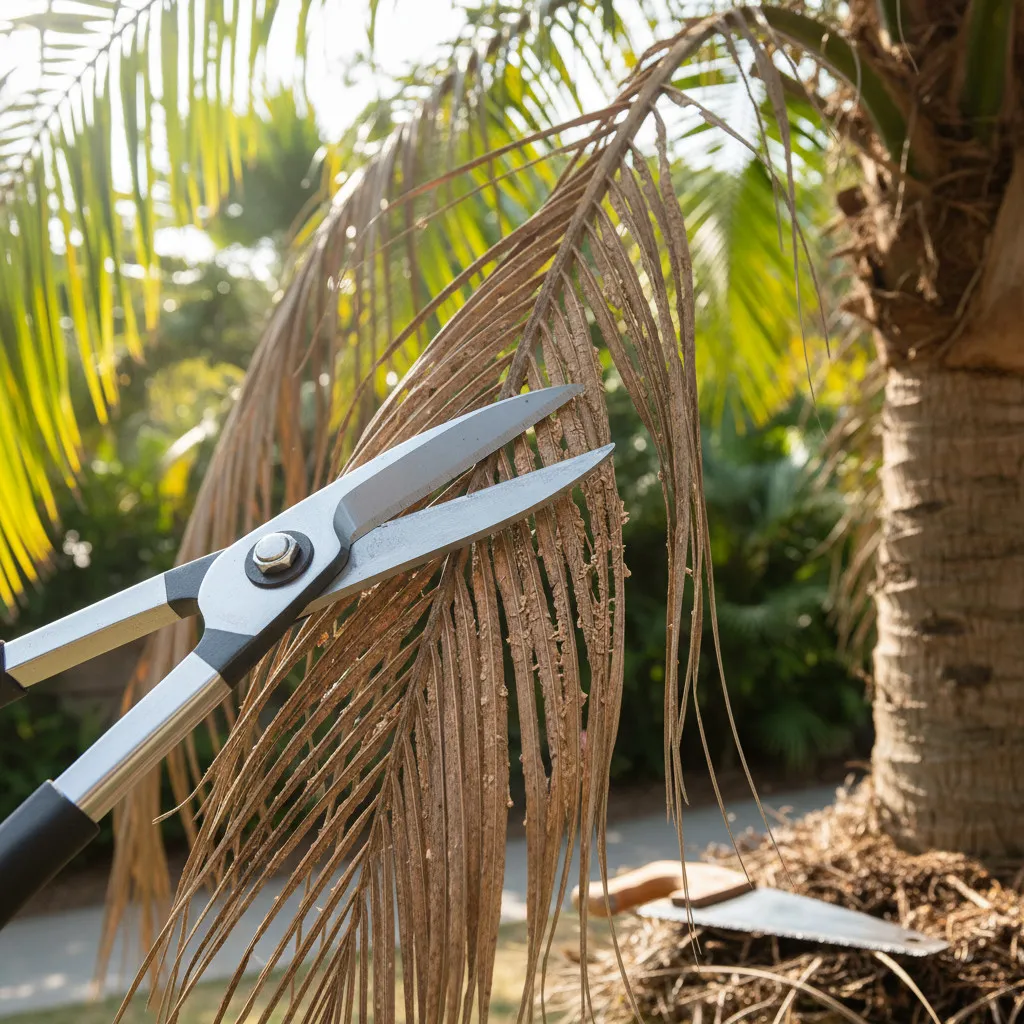
Gather appropriate tools: Use sharp, clean loppers or hand pruners for smaller fronds and a handsaw for larger, thicker stems. Dull tools create ragged cuts that heal slowly and invite disease.
-
Sterilize your equipment: Before pruning, wipe blades with rubbing alcohol or a 10% bleach solution to prevent spreading diseases between cuts or between trees. Re-sterilize if you encounter any diseased tissue.
-
Cut at the proper location: Trim dead fronds back to within 2 inches of the trunk, but never cut into the trunk itself. Damage to the trunk creates entry points for pests and pathogens that can seriously harm or kill your palm.
-
Maintain the proper angle: Cut fronds at approximately a 45-degree angle from the trunk to prevent water from pooling on the cut surface, which can encourage fungal infections.
-
Observe the 9-to-3 rule: Imagine a clock face on your palm’s canopy. Never remove fronds that are positioned between 9 o’clock and 3 o’clock (the upper half of the canopy). Only fronds below this horizontal line should be considered for removal.
Soil and Mulching Best Practices
The foundation of palm tree health lies literally in the ground—proper soil conditions and mulching practices support robust root development and help palms access the water and nutrients they need.
Ideal Soil Conditions
Palm trees generally prefer loose, well-draining soil that doesn’t become waterlogged after rain or irrigation. While palms adapt to various soil types, understanding your soil’s characteristics helps you adjust care practices accordingly.
Optimal soil characteristics for palms:
- Drainage: Well-draining soil prevents root rot, which is one of the most common causes of palm death
- pH level: Slightly acidic to neutral (pH 5.5-7.5) allows optimal nutrient uptake
- Texture: Sandy loam provides the ideal balance of drainage and moisture retention
- Organic matter: Moderate organic content improves soil structure and nutrient availability
If your soil is heavy clay or drains poorly, consider amending the planting area with organic matter or creating a raised mound to improve drainage. For sandy soils that drain too quickly, adding compost helps retain moisture and nutrients that would otherwise leach away.
Mulching Benefits and Application
Mulch is one of the simplest yet most effective tools for palm tree health. A proper mulch layer provides multiple benefits that directly support your palm’s growth and resilience.
Benefits of mulching around palms:
- Moisture retention: Reduces evaporation from soil, decreasing watering frequency
- Temperature regulation: Insulates roots from extreme heat and cold
- Weed suppression: Prevents competing vegetation from stealing water and nutrients
- Soil improvement: Organic mulches break down over time, adding nutrients to the soil
- Equipment protection: Creates a buffer zone that keeps lawn mowers and string trimmers away from the trunk
Proper mulch application:
Apply a 2-3 inch layer of organic mulch over the root zone, extending outward to at least 3 feet from the trunk. Keep mulch pulled back 4-6 inches from the trunk itself to prevent moisture accumulation against the bark, which can promote disease. Replenish mulch annually as it decomposes and settles.
Protecting Palm Trees from Pests and Diseases
Even well-cared-for palms can fall victim to pests and diseases, making regular inspection and prompt treatment essential components of your maintenance routine.
Common Palm Tree Pests
Several insect pests target palm trees, and early detection is crucial for successful control.
Watch for these common palm pests:
- Spider mites: Cause stippling (tiny discolored specks) on fronds; treat with neem oil or insecticidal soap
- Mealybugs: Appear as white, cottony masses at frond bases; remove with rubbing alcohol or treat with appropriate insecticides
- Scale insects: Form raised bumps on fronds and stems; control with horticultural oil applications
- Palm weevils: Bore into trunks, causing severe structural damage; require professional treatment
- Palm aphids: Oval-shaped insects that cause sooty mold; treat with targeted insecticides
Regular inspection allows you to catch infestations early when they’re easier to control. When purchasing new palms, carefully examine them for signs of pests before bringing them home to prevent introducing problems to your existing landscape.
Recognizing and Treating Palm Diseases
Palm diseases can be challenging to treat, making prevention through proper care practices your best defense.
Common palm diseases to recognize:
- Ganoderma butt rot: Causes wilting and eventual death; no cure exists, so remove and destroy infected palms
- Fusarium wilt: Causes one-sided frond death and is often fatal; no effective treatment available
- Leaf spots and blights: Fungal infections that cause brown or black spots; treat with copper-based fungicides
- Bud rot: Affects the growing point and is usually fatal; prevent by avoiding overhead irrigation
Prevention strategies:
- Avoid wounding the trunk during maintenance activities
- Don’t overwater, as soggy conditions promote fungal diseases
- Space palms properly for good air circulation
- Sterilize pruning tools between trees
- Remove and dispose of infected plant material promptly
Cold Weather Protection and Winter Care
If you live in an area that experiences occasional frost or freezing temperatures, protecting your palms during cold snaps can mean the difference between survival and loss.
Preparing palms for cold weather:
-
Water thoroughly the day before predicted cold weather arrives. Well-hydrated soil retains heat better than dry soil and helps insulate the root system from freezing temperatures.
-
Apply extra mulch over the root zone, building up to 4-6 inches of organic material to provide additional insulation for the roots.
-
Wrap trunks with burlap or frost cloth on palms that are borderline hardy for your area. This is especially important for young palms that haven’t developed full cold tolerance.
-
String holiday lights through the canopy of smaller palms—the gentle heat from incandescent bulbs can add 2-3 degrees of protection on cold nights.
-
Move container palms indoors or to a protected area like a garage when temperatures are expected to drop below their tolerance threshold.
After a freeze:
If your palm suffers cold damage, resist the urge to prune immediately. Wait until spring to assess the true extent of damage, as fronds that appear dead may recover, and premature pruning can expose the bud to additional cold events.
Indoor Palm Tree Care Essentials
Growing palms indoors requires attention to specific environmental factors that differ from outdoor cultivation.
Light and Humidity Requirements
Indoor palms need adequate light to maintain health and growth, though requirements vary by species. Most indoor palms prefer bright, indirect light—direct sun through windows can scorch fronds.
Humidity is often the biggest challenge for indoor palms:
- Most homes have humidity levels of 30-50%, while tropical palms prefer 50-70%
- Mist your palm several times weekly or use a pebble tray filled with water beneath the pot
- Group plants together to create a humid microclimate
- Consider using a humidifier near your palms, especially during winter when heating dries indoor air
Potting and Repotting Guidelines
Container-grown palms require well-draining potting mix and appropriate pot size to thrive.
Best practices for container palm care:
- Use a fast-draining potting mix formulated for palms, cacti, or citrus
- Choose containers with adequate drainage holes
- Repot only when the palm becomes severely root-bound, typically every 2-3 years
- When repotting, move to a container only slightly larger than the current one
- Never plant deeper than the palm was previously growing
Key Takeaways: Your Palm Tree Care Checklist
Caring for palm trees successfully comes down to understanding their unique needs and responding appropriately to your specific growing conditions. Here’s a quick reference to keep your palms thriving:
✓ Choose the right palm for your climate, light conditions, and available space
✓ Water deeply but infrequently, allowing soil to partially dry between waterings
✓ Fertilize with palm-specific products three to four times during the growing season
✓ Prune only dead fronds that have turned completely brown
✓ Maintain proper mulch around the base while keeping it away from the trunk
✓ Monitor for pests and diseases regularly, treating problems promptly
✓ Protect from cold when temperatures threaten to drop below your palm’s tolerance
✓ Provide adequate humidity for indoor palms through misting or humidifiers
With these fundamentals in place, your palm trees will reward you with years of tropical beauty, transforming your landscape or living space into the relaxing retreat you’ve always imagined. Remember that palm care is not about perfection—it’s about consistency and attention to your trees’ needs. Start implementing these practices today, and watch your palms flourish into stunning specimens that bring joy to everyone who sees them.
![How To Grow A Pear Tree From Seed [Step-By-Step Guide]](https://fruitonix.com/wp-content/uploads/2023/06/Screenshot-2023-06-07-1.36.07-AM.png)