Few food pairings in the German culinary tradition carry the same soul-warming authority as bratwurst and spaetzle. One is a coarsely seasoned pork sausage with a crackling skin and savory depth that varies from region to region across Germany. The other is a soft, pillowy egg dumpling — technically a noodle, practically a hug — that soaks up sauces, browns beautifully in butter, and holds its own alongside the boldest of flavors. Together, they make a plate that doesn’t just fill you up; it makes you slow down and actually enjoy dinner.
What’s worth knowing before you start cooking is that spaetzle isn’t complicated. A lot of home cooks assume it requires specialist equipment or years of experience. It doesn’t. The batter is essentially flour, eggs, and milk — pushed through a colander, a box grater, or a proper spaetzle maker into boiling salted water. The noodles rise to the surface in about two minutes, and from there, the flavor possibilities branch out in a dozen directions. That’s the beauty of this particular base: it pairs with cheese sauces, sauerkraut, mushroom gravy, caramelized onions, roasted vegetables, and more.
The eight recipes here range from weeknight-fast to low-and-slow weekend cooking. Some lean into the classic Bavarian pub-food spirit — golden spaetzle, snappy brats, tangy mustard. Others push the combination in more creative directions, folding in sweet potatoes, lentils, smoky bacon, and rich mushroom gravy. Whether you’re cooking for two on a Tuesday or feeding a table of six for an Oktoberfest dinner at home, at least one of these will earn a permanent spot in your rotation.
Table of Contents
- What Makes Bratwurst and Spaetzle Such a Strong Combination
- Homemade vs. Store-Bought Spaetzle
- Choosing the Right Bratwurst
- 1. Classic Beer-Braised Bratwurst with Buttered Spaetzle
- Ingredients
- How to Cook It
- Why This Works Every Time
- 2. Käse Spaetzle with Pan-Seared Bratwurst
- Ingredients
- How to Cook It
- The Key to Getting the Cheese Layer Right
- 3. Krautspaetzle — Sauerkraut Spaetzle with German Sausages
- Ingredients
- How to Cook It
- 4. Bratwurst and Spaetzle Casserole with Apple, Bacon, and Sauerkraut
- Ingredients
- How to Cook It
- 5. Spaetzle with Bratwurst, Sweet Potatoes, and Caramelized Onions
- Ingredients
- How to Cook It
- Why Sweet Potato Works Here
- 6. Pan-Fried Spaetzle with Bratwurst and Mushroom Gravy
- Ingredients
- How to Cook It
- 7. Lentil and Bratwurst Stew with Pan-Fried Spaetzle
- Ingredients
- How to Cook It
- 8. Roasted Bratwurst with Peppers, Onions, and Golden Spaetzle
- Ingredients
- How to Cook It
- Why Dry Spaetzle Is Non-Negotiable Here
- Tips for Making Spaetzle at Home Without a Spaetzle Maker
- Storing, Reheating, and Getting Ahead
- What to Drink Alongside These Dishes
- Final Thoughts
What Makes Bratwurst and Spaetzle Such a Strong Combination
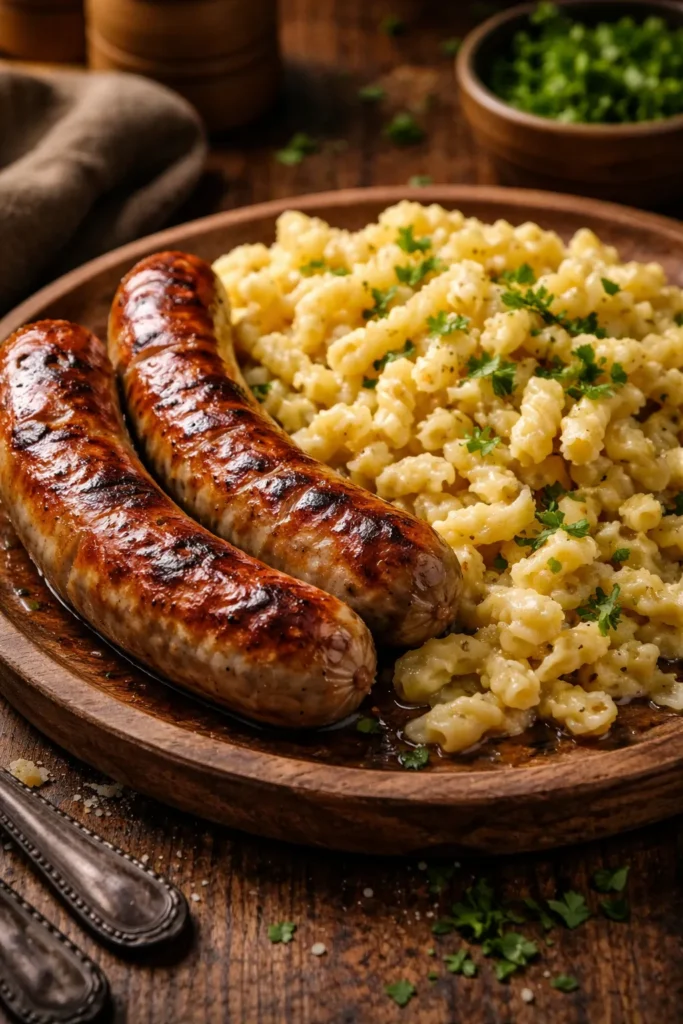
Before getting into the recipes, it’s worth understanding why this pairing works so consistently well. Bratwurst is rich, fatty, and deeply savory — the kind of flavor that demands a starchy counterpart to balance it. Spaetzle provides exactly that, but with a texture no other starch quite replicates. It’s softer than pasta, chewier than rice, and it absorbs pan drippings, melted butter, and sauces in a way that turns every forkful into something greater than its individual parts.
The word “Spätzle” comes from the Swabian dialect of German and roughly translates to “little sparrows” — a nod to the irregular, bird-like shapes the batter takes when pressed through a mold into boiling water. The dish originated in the Baden-Württemberg and Swabia regions of southern Germany, where it has been a staple side dish for centuries. Bratwurst, which translates literally to “pan sausage” or “fry sausage,” shares that southern German heritage and has been made in hundreds of regional varieties.
Together, they represent the kind of cooking that Germans call Hausmannskost — home cooking that’s hearty, honest, and designed to genuinely satisfy.
Homemade vs. Store-Bought Spaetzle
Making spaetzle from scratch is worth it when you have time. The texture is softer and more irregular, and it picks up sauces differently than the dried variety. That said, dried spaetzle — particularly brands made in Swabia, like Bechtle — holds its shape well during sautéing and produces a satisfying result with a fraction of the effort. For the recipes below, either works. Where homemade matters most (and where the texture difference is most noticeable) is in cheesy baked dishes and dishes where the spaetzle is pan-fried until golden.
Choosing the Right Bratwurst
Not all bratwurst are created equal. Nürnberger bratwurst are thin and mild, made for grilling quickly. Thüringer brats are longer and seasoned more heavily with marjoram. Standard supermarket bratwurst tend to be mild enough to work in any recipe here. If you want more depth, look for brats made with a coarser grind — those produce a meatier bite when crumbled or sliced into a dish.
1. Classic Beer-Braised Bratwurst with Buttered Spaetzle
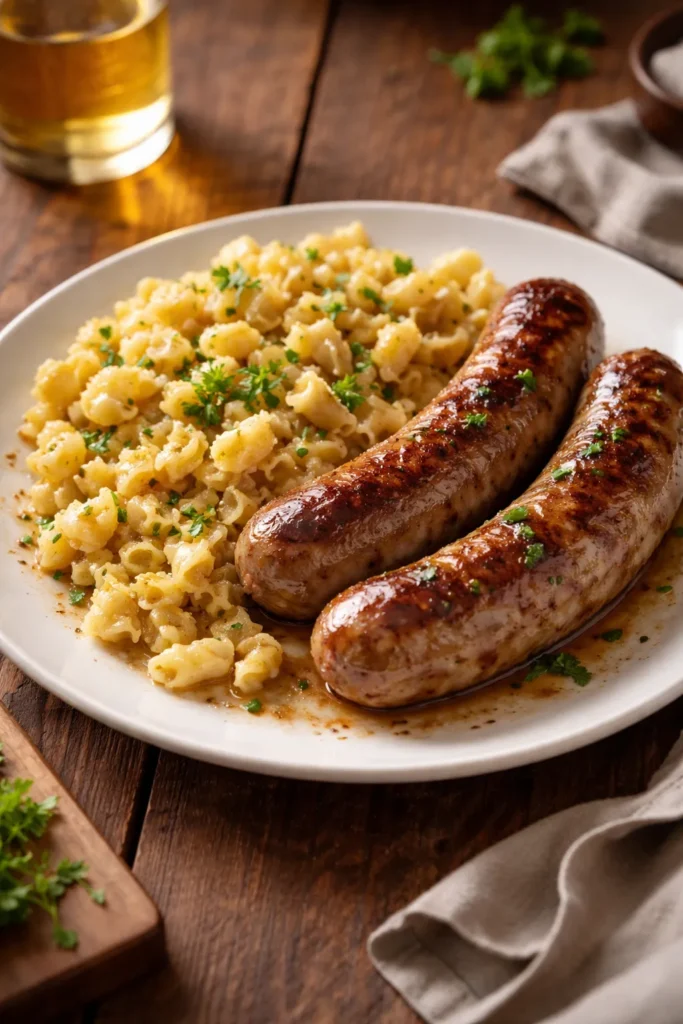
This is the dish that started everything. Beer-braised bratwurst is the most traditional way to cook these sausages, and for good reason: the slow simmer in malty lager gently cooks the brats all the way through before a quick sear locks in that golden crust. Paired with spaetzle tossed in brown butter and fresh parsley, it’s a plate that needs nothing else — except perhaps a cold German pilsner in your hand.
The technique here matters. Don’t skip the beer simmer and go straight to searing, or you risk a casing that’s scorched on the outside while the center is still underdone. The simmer takes about 30 minutes over gentle heat; the sear takes about 4 minutes in a hot cast iron. That sequence produces the best possible result.
Ingredients
- 4 bratwurst links
- 1 bottle (12 oz) German lager or pilsner
- 2 bay leaves
- 3 tablespoons unsalted butter
- 5 cups cooked spaetzle (homemade or dried, prepared per package)
- 2 tablespoons fresh flat-leaf parsley, finely chopped
- Salt and black pepper to taste
- Stone-ground or Düsseldorf mustard, for serving
How to Cook It
Place the bratwurst in a heavy saucepan and pour the beer over them. Add the bay leaves and a pinch of salt. Bring to a gentle simmer and cook for 28 to 30 minutes — the beer should bubble just enough to keep things moving. Remove the brats and pat them dry.
Heat a cast iron skillet over high heat until it smokes lightly. Sear the brats for 2 minutes per side until deeply golden and the casing is crackling and tight. Rest them for 3 minutes.
In the same skillet, melt the butter over medium heat until it turns pale golden and smells nutty — about 2 minutes. Add the cooked spaetzle and toss until every noodle is coated and heated through. Season with salt and pepper, scatter the parsley over the top, and serve with the whole brats on the side alongside a generous amount of mustard.
Why This Works Every Time
The beer simmer seasons the bratwurst from the inside, and the residual beer fat left in the pan is actually worth deglazing with a splash of the cooking liquid to make a quick pan sauce if you want to elevate it further. Brown butter on spaetzle sounds minimal, but it’s genuinely one of the best ways to let the noodle’s eggy, slightly chewy character speak for itself.
Worth knowing: Serve the brats whole without buns, the way they’re eaten across Bavaria — just a fork, a knife, and a streak of sharp mustard across the plate.
2. Käse Spaetzle with Pan-Seared Bratwurst

Think of this as Germany’s answer to macaroni and cheese — except it’s considerably better. Käse Spaetzle (pronounced kay-zuh shpate-zuhl) layers cooked spaetzle with melted cheese and caramelized onions until the whole dish becomes gloriously saucy and rich. Pan-seared bratwurst sliced over the top adds a savory, slightly charred counterpoint to all that creaminess.
The cheese you use makes a significant difference. Swiss or Emmentaler is traditional, but Gruyère adds a deeper nuttiness and Havarti melts more smoothly. A blend of Gruyère and Havarti hits the sweet spot between flavor and texture.
Ingredients
- 5 cups cooked spaetzle
- 1½ cups Gruyère, grated
- 1½ cups Havarti, grated
- 2 tablespoons unsalted butter
- 1 large yellow onion, thinly sliced
- Pinch of sugar
- 4 bratwurst links
- Salt and black pepper
How to Cook It
Start the onions first — they take the longest. Melt the butter in a wide skillet over medium-low heat, add the sliced onion and pinch of sugar, and cook slowly, stirring every 6 to 8 minutes, for 35 to 40 minutes until they are deep golden brown and sweet throughout. Don’t rush this step.
While the onions cook, sear the bratwurst in a separate pan over medium-high heat for 5 to 6 minutes, turning occasionally, until browned all over and cooked through to an internal temperature of 160°F. Slice into medallions and set aside.
In a greased baking dish, layer half the spaetzle, then half the cheese, then half the caramelized onions. Repeat the layers. Bake at 375°F for 20 minutes until the top is bubbling and the cheese has formed a golden crust in places. Arrange the bratwurst slices over the top and serve directly from the dish.
The Key to Getting the Cheese Layer Right
Don’t add cold cheese directly from the fridge to a cold spaetzle layer — the cheese won’t melt evenly. Let the grated cheese sit at room temperature for 15 minutes before assembling. Also, pat the cooked spaetzle as dry as possible; excess moisture from boiling is the most common reason Käse Spaetzle turns watery instead of creamy.
Pro tip: A cast iron skillet gives you better crust development on the bottom layer than a glass baking dish. Run it under the broiler for the last 3 minutes to finish.
3. Krautspaetzle — Sauerkraut Spaetzle with German Sausages

Krautspaetzle is a traditional dish from the Swabia region that appears at German fairs, Biergartens, and home kitchens alike. It combines cooked spaetzle with braised sauerkraut, crispy bacon, sautéed onions, and grilled bratwurst — and the result is savory, tangy, and deeply satisfying in a way that’s distinctly different from the other recipes here.
The sauerkraut is the star supporting actor. Braise it for 15 minutes with juniper berries, a bay leaf, and a splash of white wine, and it transforms from sharp and jarring into mellow and complex. Hengstenberg Mildessa is the brand name that shows up repeatedly in German cooking circles for good reason — it’s balanced and not aggressively sour.
Ingredients
- 18 oz dried spaetzle, cooked al dente
- 28 oz sauerkraut (Bavarian-style, ideally)
- ½ teaspoon juniper berries
- 1 bay leaf
- 2 fl oz dry white wine
- 1 cup diced bacon (about 4 oz)
- 1 yellow onion, finely chopped
- 3 tablespoons unsalted butter
- 4 bratwurst links
- Salt and black pepper
- Fresh flat-leaf parsley, chopped, for garnish
How to Cook It
Combine the sauerkraut, juniper berries, bay leaf, and white wine in a small saucepan. Cook over medium-low heat for 15 minutes, stirring occasionally, until softened and fragrant. Discard the bay leaf and set aside.
In a large skillet, melt the butter over medium heat. Add the diced bacon and cook until the fat has rendered and the pieces are crisp, about 8 minutes. Add the chopped onion and cook another 5 minutes until softened and lightly golden at the edges.
Add the cooked spaetzle to the skillet and toss with the bacon and onion. Cook for 5 to 7 minutes, stirring occasionally, until the spaetzle picks up some color. Stir in the braised sauerkraut and cook for another 3 minutes to bring everything together. Season with salt and pepper.
Fry or grill the bratwurst separately until the skin is golden and lightly charred. Serve whole or sliced over the spaetzle, scattered with fresh parsley.
Worth knowing: Caraway seeds make a traditional substitution for juniper berries if you can’t find them — use about ½ teaspoon.
4. Bratwurst and Spaetzle Casserole with Apple, Bacon, and Sauerkraut
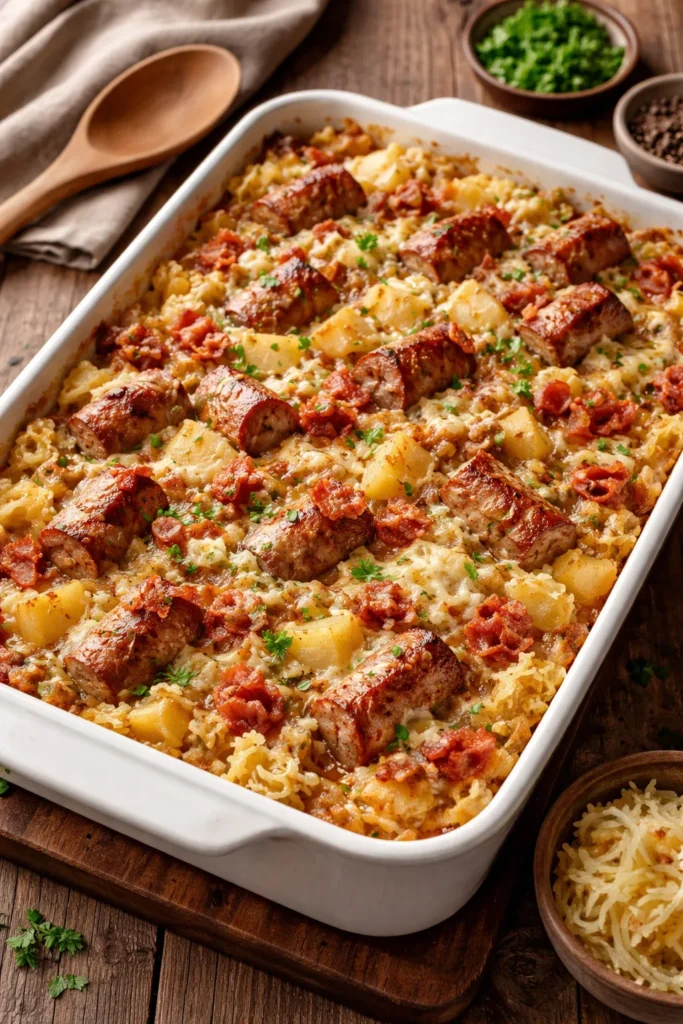
This baked casserole takes the Krautspaetzle concept and adds a low-and-slow oven finish that makes it ideal for feeding a crowd. The unexpected addition of apple and brown sugar might raise an eyebrow, but it rounds out the sauerkraut’s acidity in a way that makes the whole casserole feel more cohesive. Home cooks who’ve made this recipe consistently report that even self-declared sauerkraut skeptics come back for seconds.
It reheats exceptionally well the next day — better than most casseroles, actually, because the spaetzle absorbs more flavor overnight.
Ingredients
- 1⅓ cups all-purpose flour
- 1 teaspoon salt
- 3 large eggs
- ⅓ cup water
- 2 strips thick-cut bacon, diced
- ½ large onion, chopped
- 2 tablespoons unsalted butter
- 1 small Gala apple, cored and finely chopped
- 2 tablespoons brown sugar
- 16 oz sauerkraut, drained
- 16 oz kielbasa or bratwurst, cut into 2-inch pieces
- 1 teaspoon vegetable oil (for the colander)
How to Cook It
Preheat the oven to 350°F. Make the spaetzle batter by whisking together flour and salt, then beating in eggs and water until a thick, sticky dough forms. Rest for 10 minutes.
Bring a large pot of salted water to a boil. Grease a colander with the vegetable oil and set it over the pot. Push the dough through in batches with a flexible spatula, cooking each batch until the spaetzle floats — about 5 minutes. Transfer to an ungreased 9×9-inch baking dish with a slotted spoon.
Cook the diced bacon in a large skillet over medium heat until crisp, about 8 minutes. Set aside, leaving the drippings in the pan. Cook the onion in the drippings for 10 minutes until browned. Remove to a bowl.
Melt the butter in the same skillet, add the apple and brown sugar, and cook for 5 minutes until the apple softens. Stir in the bacon, onion, and drained sauerkraut and cook another 5 minutes.
Spread the sauerkraut mixture over the spaetzle in the baking dish. Add the sausage pieces on top. Bake for 15 minutes until bubbling and everything is heated through.
Pro tip: Brown the kielbasa or bratwurst pieces in the skillet before adding to the casserole — that caramelized exterior holds up much better during baking than raw sausage does.
5. Spaetzle with Bratwurst, Sweet Potatoes, and Caramelized Onions
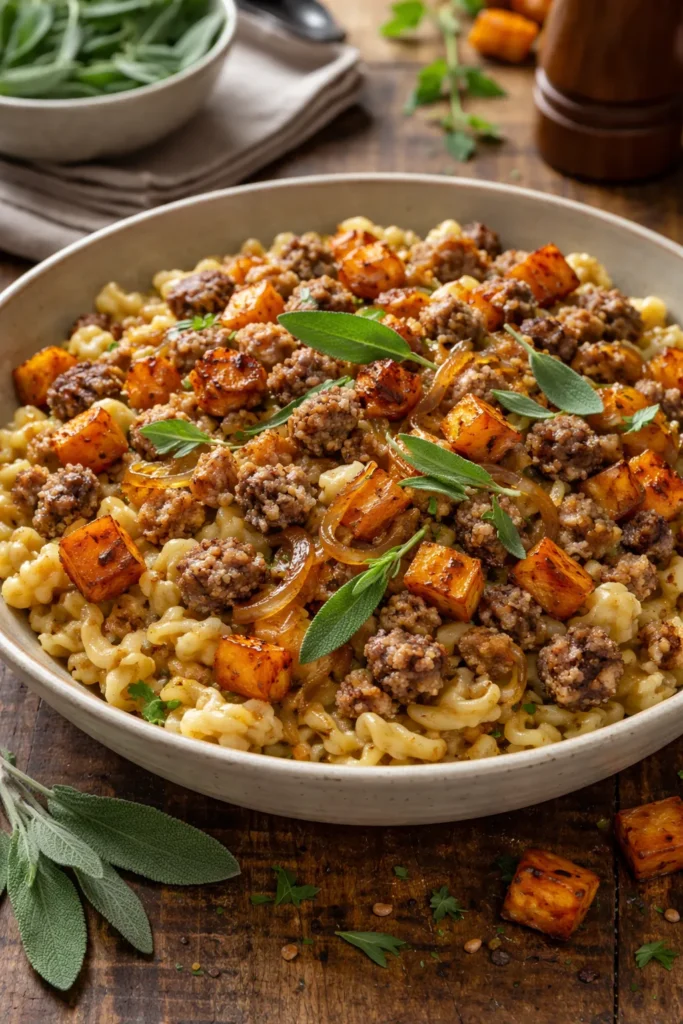
This is the recipe that converts people who think German food is one-dimensional. Roasted sweet potato cubes add natural sweetness and a beautiful color contrast, while Gruyère and Havarti melt between the spaetzle layers into a cheesy, bubbling interior. Fresh sage scattered over the top before serving adds an herbal note that ties everything together.
The bratwurst here is removed from its casing and cooked as crumbles, which means every bite of the finished dish has a little meat rather than having to cut through a whole sausage link.
Ingredients
- 2 tablespoons unsalted butter
- 1 large sweet yellow onion, uniformly sliced
- Pinch of granulated sugar
- 1 medium sweet potato, cut into 1-inch cubes
- 1 tablespoon olive oil
- Salt and freshly cracked black pepper
- 12 oz bratwurst links (3 to 4 links)
- 5 cups cooked spaetzle
- 1½ cups Havarti, grated
- 1½ cups Gruyère, grated
- Fresh sage leaves, chopped, for garnish
How to Cook It
Start the caramelized onions first — this is a commitment. Melt the butter in a wide skillet over medium-low heat, add the sliced onion and pinch of sugar, and cook slowly for 35 to 40 minutes, stirring every 7 to 8 minutes, until deeply golden. Patience here is rewarded.
Toss the sweet potato cubes with olive oil, salt, and pepper. Roast at 425°F for 20 minutes until the edges caramelize and the centers are tender when pierced with a fork.
Slit the bratwurst casings lengthwise and squeeze out the ground meat. Cook in a skillet over medium heat, breaking it up with a spoon, for 10 to 12 minutes until fully cooked and no longer pink. Transfer to a paper towel-lined plate.
Reduce the oven to 400°F. Grease a 9×13-inch baking dish. Layer in half the spaetzle, then half the Havarti and Gruyère, then half the bratwurst crumbles, sweet potato, and caramelized onions. Repeat the layers. Bake for 18 to 20 minutes until the cheese is fully melted and beginning to bubble at the edges. Finish with fresh sage and serve immediately.
Why Sweet Potato Works Here
Sweet potato might seem like an odd addition to a German sausage dish, but its natural sugars caramelize during roasting and act as a counterweight to the richness of the bratwurst fat and the nutty depth of the Gruyère. The textural contrast between the soft potato cubes and the slightly chewy spaetzle is also part of the appeal.
6. Pan-Fried Spaetzle with Bratwurst and Mushroom Gravy
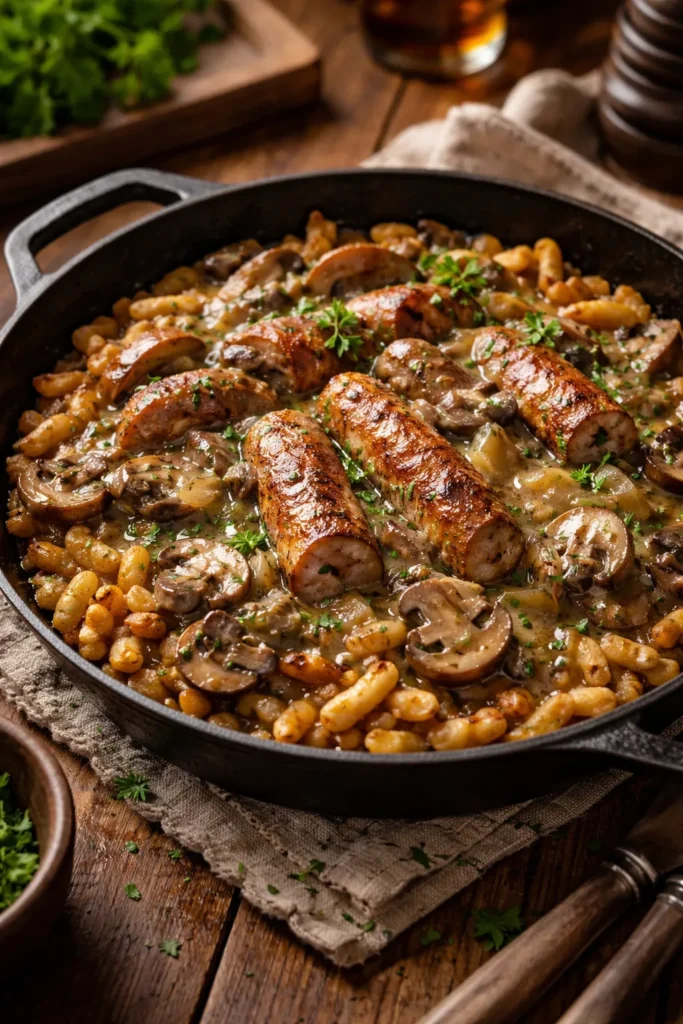
This recipe pulls from the German tradition of Jägersauce — a hunter’s mushroom sauce that’s one of the great German pan gravies. Here it’s served over crispy pan-fried spaetzle and sliced seared bratwurst, creating a dish that’s simultaneously crispy, tender, saucy, and savory all at once.
The secret to the mushroom gravy is using strong beef broth — it gives the sauce backbone that a weaker broth simply can’t provide. If you have beef broth base (the kind in a jar), use an extra teaspoon of it to punch up the flavor. The cornstarch slurry gives the gravy a glossy, restaurant-style finish.
Ingredients
For the Mushroom Gravy:
- 6 tablespoons unsalted butter, divided
- 1 yellow onion, finely chopped
- 1 clove garlic, minced
- 16 oz cremini mushrooms, sliced
- 2 cups strong beef broth
- ½ teaspoon salt
- ¼ teaspoon black pepper
- 1 tablespoon cornstarch dissolved in 2 tablespoons cold water
- Fresh flat-leaf parsley, chopped
For the Spaetzle and Brats:
- 5 cups cooked spaetzle, patted completely dry
- 2 tablespoons unsalted butter or neutral oil
- 4 German bratwurst links
How to Cook It
Make the gravy first. Melt 2 tablespoons of butter in a large skillet over medium-high heat. Add the onion and cook until golden and beginning to brown at the edges, 6 to 8 minutes. Add the garlic and cook one minute more. Add the mushrooms and cook for 7 to 8 minutes, until all the liquid has evaporated and the mushrooms begin to color. Pour in the beef broth, add salt and pepper, bring to a boil, then reduce heat and simmer for 8 minutes. Stir in the cornstarch slurry and cook for 2 minutes until the gravy coats the back of a spoon cleanly. Stir in the remaining 4 tablespoons of butter off the heat until incorporated. Keep warm.
Score the bratwurst diagonally across their length in shallow cuts about ½ inch apart — this helps the sausage cook evenly and makes for cleaner slices. Pan fry in a hot skillet until browned and crispy, about 4 to 5 minutes per side. Slice and set aside.
In a separate large skillet, melt 2 tablespoons of butter over medium-high heat. Add the spaetzle in a single layer — work in two batches if necessary; overcrowding the pan steams the noodles rather than crisping them. Cook without stirring for 3 minutes until the underside is golden, then toss and cook another 2 minutes.
Plate the pan-fried spaetzle, arrange the sliced brats over the top, and spoon the mushroom gravy generously over everything. Scatter with parsley and serve immediately.
7. Lentil and Bratwurst Stew with Pan-Fried Spaetzle
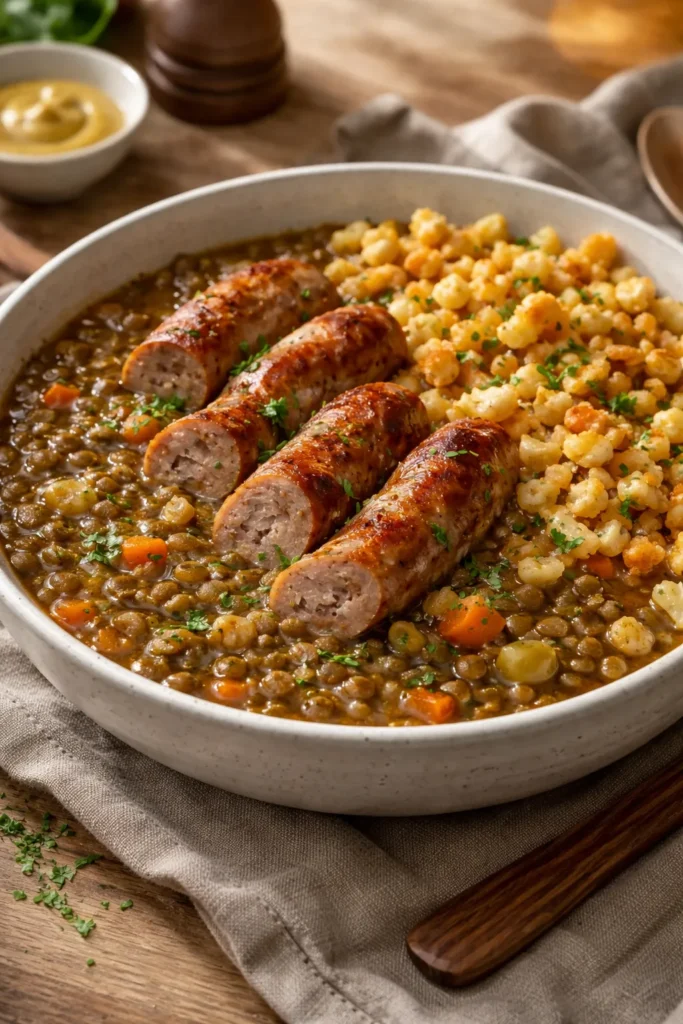
This one draws inspiration from a meal that’s been eaten in Berlin kitchens for generations — hearty green lentil stew layered with the earthy richness of bratwurst, served alongside (or on top of) crispy pan-fried spaetzle. The vinegar in the lentil base keeps the whole bowl from feeling too heavy.
It’s a different format than the other recipes here: the spaetzle isn’t mixed into the stew but served alongside as a textured base that the stew is ladled over. That contrast — soft, savory lentils against the golden, crispy spaetzle — is what makes this particular preparation memorable.
Ingredients
For the Stew:
- 1 tablespoon neutral cooking oil
- 1 large onion, finely diced
- 2 garlic cloves, minced
- 1 large carrot, finely diced
- 2 celery stalks, finely diced
- 400g (about 14 oz) green lentils, rinsed
- 600ml vegetable or chicken stock (more as needed)
- 1 teaspoon red wine vinegar
- 2 bay leaves
- Salt and black pepper to taste
- Fresh flat-leaf parsley, for serving
For the Spaetzle and Brats:
- 4 bratwurst links
- 400g (about 14 oz) cooked spaetzle, completely dry
- 2 tablespoons unsalted butter
How to Cook It
Heat the oil in a large heavy pot over medium heat. Add the onion and garlic and cook for 4 to 5 minutes until softened. Add the carrot and celery and stir to combine. Add the rinsed lentils and stir to coat them in the aromatics.
Pour in 400ml of the stock, add the vinegar, bay leaves, salt, and pepper. Bring to a boil, then reduce to a gentle simmer. Cook, partially covered, for 30 to 40 minutes until the lentils are tender and the liquid has reduced but there’s still enough to make a loose, scoopable stew. Add the remaining stock gradually if needed — some lentil varieties absorb liquid faster than others.
While the stew finishes, cook the bratwurst by your preferred method (grill, pan fry, or broil) until golden and cooked through. Slice or serve whole.
Pan fry the dried spaetzle in butter over medium-high heat for 4 to 5 minutes until golden and lightly crisp in spots. Season with salt.
Spoon the spaetzle into bowls, ladle the lentil stew over the top, and nestle the bratwurst alongside. Scatter fresh parsley and serve with a mustard on the side.
Worth knowing: If you want to add more smoke and depth, stir in 100g of diced pancetta or smoked ham when cooking the vegetables. The smokiness plays beautifully against the earthy lentils.
8. Roasted Bratwurst with Peppers, Onions, and Golden Spaetzle
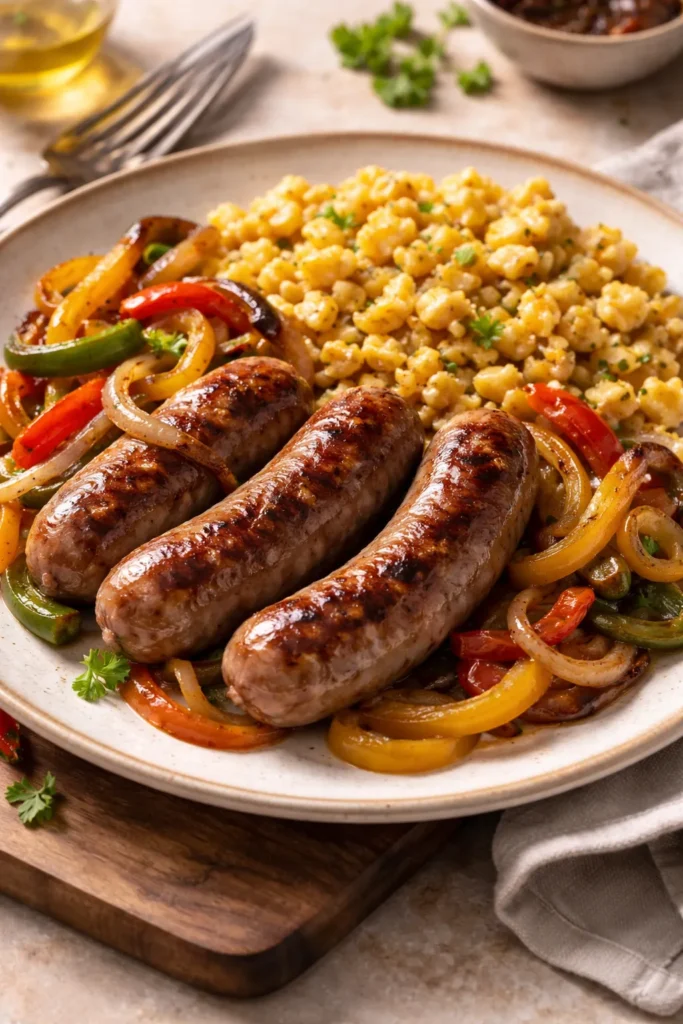
This is the weeknight version of the lineup — straightforward, adaptable, and on the table in under an hour. A mustard vinaigrette goes onto the sheet pan with the sausages, bell peppers, and onions before everything roasts together at high heat until caramelized and sweet. The spaetzle is cooked separately on the stovetop and tossed in the pan drippings to finish.
No grill required. The oven does everything.
Ingredients
For the Sheet Pan:
- 5 bratwurst links
- 3 bell peppers (a mix of colors), sliced into ¼-inch strips
- 1 large onion, sliced into ¼-inch strips
- 2 tablespoons olive oil
- 1 tablespoon red wine vinegar
- ½ tablespoon stone-ground mustard
- ¼ teaspoon garlic powder
- Salt and freshly cracked black pepper
For the Spaetzle:
- 5 cups cooked spaetzle, completely dry
- 2 tablespoons unsalted butter or the reserved drippings from the sheet pan
- Salt and pepper
How to Cook It
Preheat the oven to 400°F. Whisk together the olive oil, red wine vinegar, stone-ground mustard, garlic powder, salt, and pepper in a small bowl to make the vinaigrette.
Spread the bell pepper strips and onion strips across a large rimmed baking sheet. Add the bratwurst links. Pour the vinaigrette over everything and toss until evenly coated.
Roast for 20 minutes, then pull the pan out and give everything a good stir — the vegetables should be softening and beginning to color. Return to the oven for another 20 to 25 minutes until the peppers and onions are caramelized at the edges and the bratwurst has browned, tightened, and developed some char in spots.
Rest the bratwurst for 5 minutes before slicing. Meanwhile, melt the butter in a large skillet over medium-high heat (or use the collected drippings from the sheet pan, which are loaded with flavor). Add the dry spaetzle and cook for 4 to 5 minutes, tossing occasionally, until golden. Season with salt and pepper.
Plate the spaetzle and pile the roasted peppers, onions, and sliced brats over the top. A small pot of sharp mustard on the table is strongly recommended.
Why Dry Spaetzle Is Non-Negotiable Here
Wet spaetzle going into a hot pan steams rather than crisps — and you end up with soft, pale noodles instead of the golden, slightly chewy result you’re after. After boiling and draining, spread the spaetzle on a clean kitchen towel or paper towels and pat well. Even 5 minutes of air-drying makes a noticeable difference in the final texture.
Tips for Making Spaetzle at Home Without a Spaetzle Maker
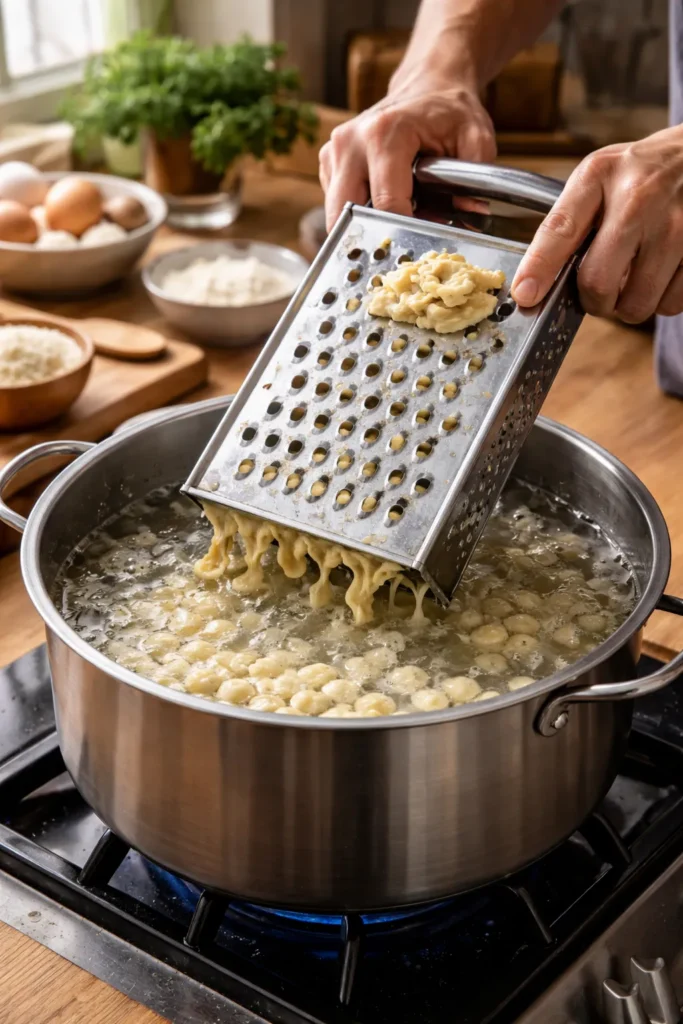
Not everyone owns the sliding-disc tool that makes spaetzle production effortless. The good news is that a large-holed cheese grater or a sturdy colander with holes at least ¼ inch in diameter works perfectly well. Place the batter — which should be thick and sticky, considerably thicker than pancake batter — on the back of the grater or inside the colander, hold it directly over the boiling water, and use a flexible spatula or bench scraper to push small portions through the holes.
Work in small batches. Feeding too much batter into the water at once causes the noodles to clump together and cook unevenly. Once the spaetzle floats — usually within 90 seconds to 2 minutes — scoop it out with a spider or slotted spoon and transfer it to an ice water bath immediately. This stops the cooking and preserves the texture. Drain well and toss lightly with olive oil to prevent sticking.
Rest the batter. Every recipe above benefits from a 10 to 15-minute rest after mixing. Resting lets the gluten relax, which produces a noticeably softer, more tender noodle. It’s a step most shortcuts skip and most good cooks don’t.
Storing, Reheating, and Getting Ahead
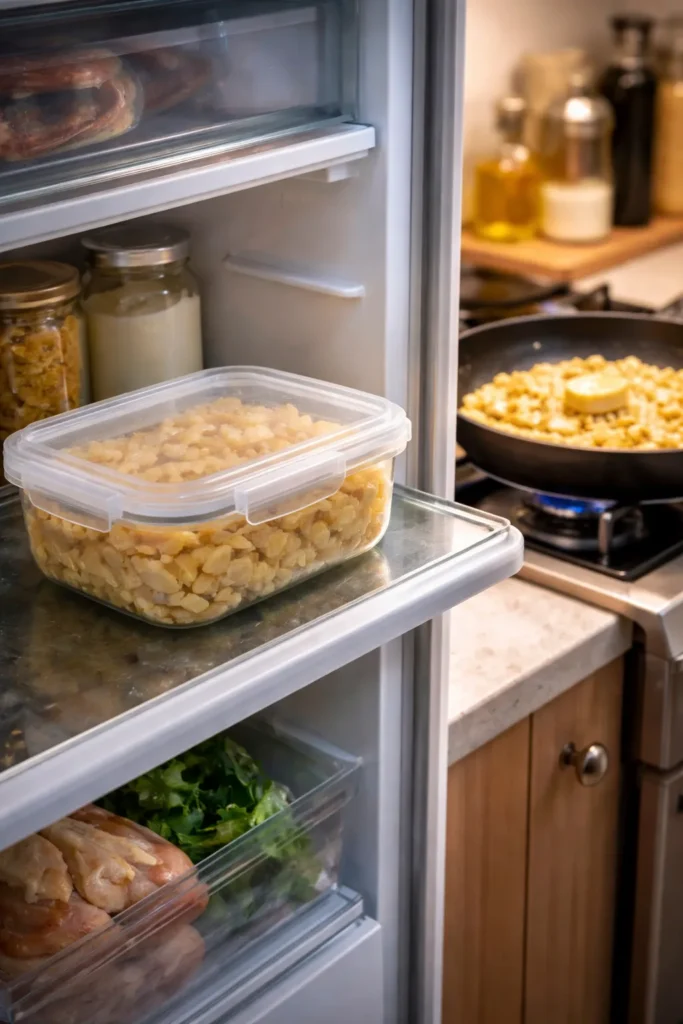
Most of these dishes store well in the refrigerator for up to 3 days in a sealed container. The spaetzle-heavy preparations (particularly the casseroles) often taste better the next day once the flavors have had time to settle into one another.
For reheating, a skillet with a small knob of butter over medium heat is almost always the best approach. A microwave works, but it softens the spaetzle and can make the bratwurst rubbery. If you’re reheating a baked casserole dish, cover it with foil at 325°F for 20 minutes to warm through without drying it out, then remove the foil for the last 5 minutes to re-crisp the top.
Spaetzle on its own (without bratwurst or sauce) freezes well. Spread it in a single layer on a baking sheet, freeze until solid, then transfer to a freezer bag. It keeps for up to 2 months and reheats directly from frozen in a buttered skillet. Full assembled dishes (particularly the cheesy baked versions) don’t freeze as cleanly — the texture of both the cheese and the spaetzle changes during thawing.
One make-ahead tip worth mentioning: spaetzle batter can be prepared up to 24 hours in advance and kept covered in the refrigerator. Give it a quick stir before using and press on as normal. It actually boils up slightly more tender from a cold, rested batter.
What to Drink Alongside These Dishes

German food and German beer are a natural partnership, and these recipes are no exception. A Märzen-style lager — the amber, malt-forward beer synonymous with Oktoberfest — is the most versatile choice across the board. Its bread-like, slightly sweet malt character complements bratwurst fat and cheesy spaetzle alike without overpowering either.
For the lentil stew or the mushroom gravy dish, a Dunkel (dark lager) or even a German-style bock adds a layer of roasty depth that echoes the earthiness of the dish. If you’re serving the roasted pepper and onion version on a warm night, a cold Kölsch — lighter and more crisp than a Märzen — is a natural match.
Wine works too. A German Spätburgunder (Pinot Noir) has the earthy, slightly smoky character to hold its own alongside bratwurst, and its moderate tannins don’t compete with the richness of cheese-sauced spaetzle the way a bigger red might.
Final Thoughts
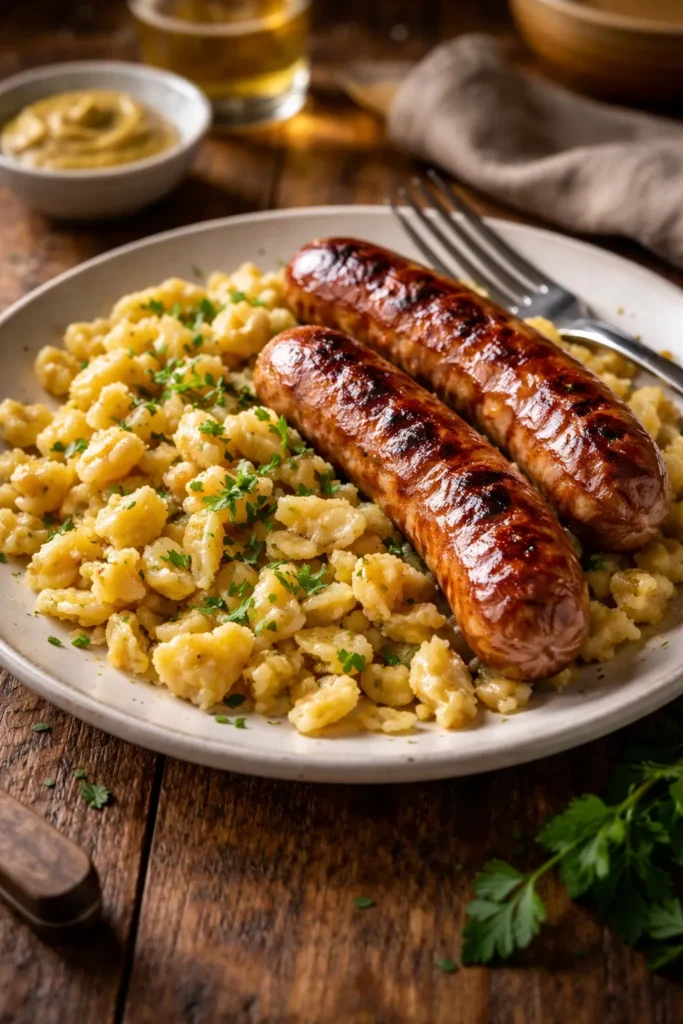
The bratwurst and spaetzle combination rewards experimentation more than almost any other food pairing in German cooking. Once you’re comfortable making basic spaetzle — whether from scratch or with dried noodles — the variations are practically endless. The eight recipes here cover everything from the simplest weeknight plate (beer-braised brats, buttered spaetzle, mustard) to a proper baked casserole that serves a crowd.
The one thing every version has in common: dry your spaetzle before it hits a hot pan. That single step is the difference between pale, steamed noodles and the golden, slightly chewy result that makes this dish worth making over and over again.
Start with the recipe that sounds most appealing and work outward from there. If you haven’t made spaetzle before, the classic beer-braised version is the most forgiving entry point — minimal components, maximum payoff. And if you’re already a convert, the sweet potato and caramelized onion bake or the mushroom gravy version will give you something genuinely new to work toward.
Guten Appetit.